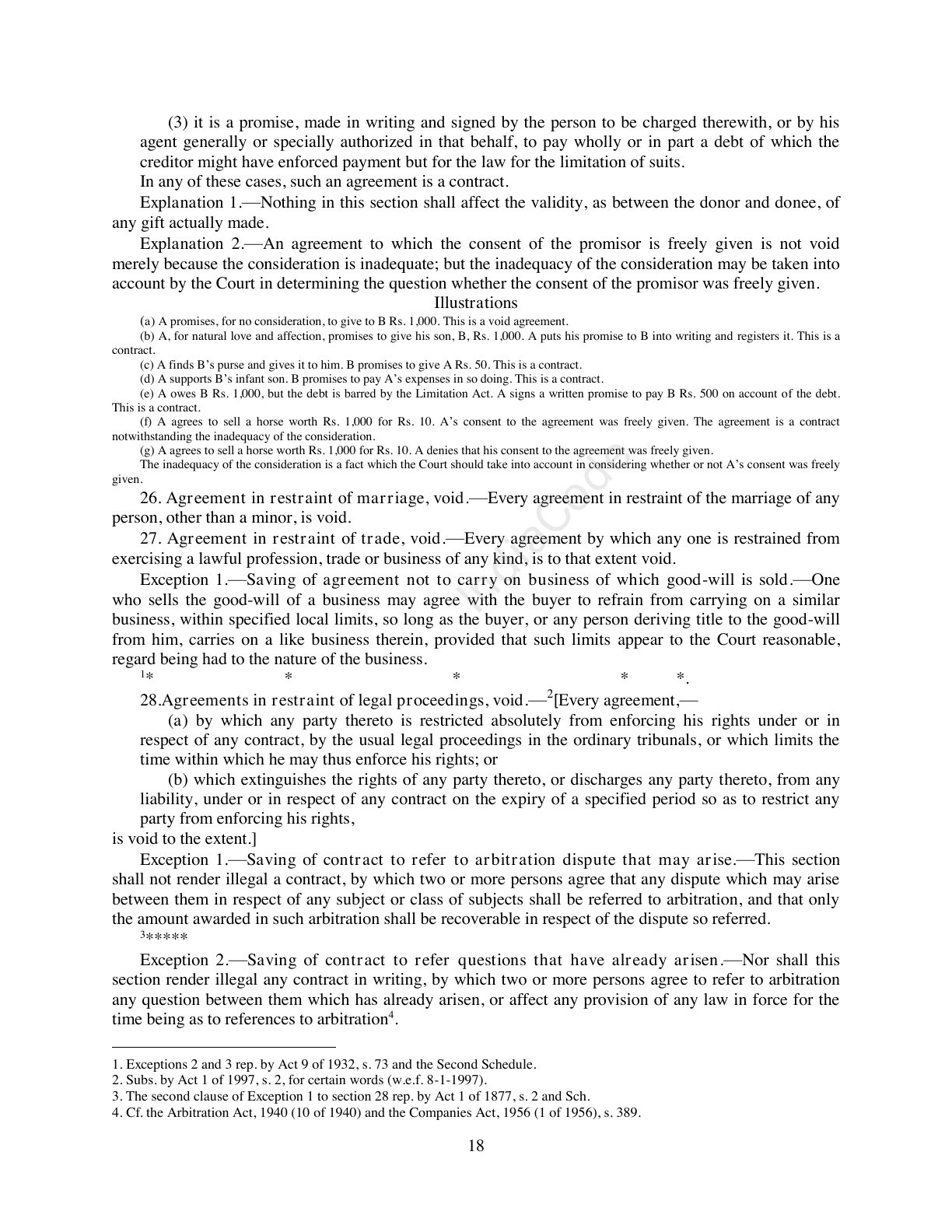
Full physical source page · unreviewed extraction
The Indian Contract Act, 1872: page 18
The Indian Contract Act, 1872, India Code delivered snapshot 85a7a066098255c9, physical page 18. Unreviewed extraction.
Source: official India Code PDF · catalog record. Fetched 2026-10-19T23:06:49Z. SHA-256 85a7a066098255c93001d678aeaf483f91d3080918363c03b78d40c3eeb8b386.
Legal currency, territorial applicability and extraction fidelity are unverified. Catalog checksum/size differs from the delivered PDF; both identities are retained. Sections, state notes and footnotes share these physical pages. Compare the full original image.
Retained layout text
         (3) it is a promise, made in writing and signed by the person to be charged therewith, or by his
    agent generally or specially authorized in that behalf, to pay wholly or in part a debt of which the
    creditor might have enforced payment but for the law for the limitation of suits.
    In any of these cases, such an agreement is a contract.
    Explanation 1.—Nothing in this section shall affect the validity, as between the donor and donee, of
any gift actually made.
    Explanation 2.—An agreement to which the consent of the promisor is freely given is not void
merely because the consideration is inadequate; but the inadequacy of the consideration may be taken into
account by the Court in determining the question whether the consent of the promisor was freely given.
                                                Illustrations
     (a) A promises, for no consideration, to give to B Rs. 1,000. This is a void agreement.
      (b) A, for natural love and affection, promises to give his son, B, Rs. 1,000. A puts his promise to B into writing and registers it. This is a
contract.
      (c) A finds B’s purse and gives it to him. B promises to give A Rs. 50. This is a contract.
      (d) A supports B’s infant son. B promises to pay A’s expenses in so doing. This is a contract.
      (e) A owes B Rs. 1,000, but the debt is barred by the Limitation Act. A signs a written promise to pay B Rs. 500 on account of the debt.
This is a contract.
      (f) A agrees to sell a horse worth Rs. 1,000 for Rs. 10. A’s consent to the agreement was freely given. The agreement is a contract
notwithstanding the inadequacy of the consideration.
      (g) A agrees to sell a horse worth Rs. 1,000 for Rs. 10. A denies that his consent to the agreement was freely given.

given.
                                                                                                e
      The inadequacy of the consideration is a fact which the Court should take into account in considering whether or not A’s consent was freely

                                                                                        od
    26. Agreement in restraint of marriage, void.—Every agreement in restraint of the marriage of any
person, other than a minor, is void.
                                                                               aC
    27. Agreement in restraint of trade, void.—Every agreement by which any one is restrained from
exercising a lawful profession, trade or business of any kind, is to that extent void.
                                                                         di
    Exception 1.—Saving of agreement not to carry on business of which good-will is sold.—One
                                                                   In
who sells the good-will of a business may agree with the buyer to refrain from carrying on a similar
business, within specified local limits, so long as the buyer, or any person deriving title to the good-will
from him, carries on a like business therein, provided that such limits appear to the Court reasonable,
regard being had to the nature of the business.
    1
      *                    *                       *                          *        *.
    28.Agreements in restraint of legal proceedings, void.— [Every agreement,—
                                                                  2

         (a) by which any party thereto is restricted absolutely from enforcing his rights under or in
    respect of any contract, by the usual legal proceedings in the ordinary tribunals, or which limits the
    time within which he may thus enforce his rights; or
         (b) which extinguishes the rights of any party thereto, or discharges any party thereto, from any
    liability, under or in respect of any contract on the expiry of a specified period so as to restrict any
    party from enforcing his rights,
is void to the extent.]
    Exception 1.—Saving of contract to refer to arbitration dispute that may arise.—This section
shall not render illegal a contract, by which two or more persons agree that any dispute which may arise
between them in respect of any subject or class of subjects shall be referred to arbitration, and that only
the amount awarded in such arbitration shall be recoverable in respect of the dispute so referred.
    3
      *****
    Exception 2.—Saving of contract to refer questions that have already arisen.—Nor shall this
section render illegal any contract in writing, by which two or more persons agree to refer to arbitration
any question between them which has already arisen, or affect any provision of any law in force for the
time being as to references to arbitration4.

1. Exceptions 2 and 3 rep. by Act 9 of 1932, s. 73 and the Second Schedule.
2. Subs. by Act 1 of 1997, s. 2, for certain words (w.e.f. 8-1-1997).
3. The second clause of Exception 1 to section 28 rep. by Act 1 of 1877, s. 2 and Sch.
4. Cf. the Arbitration Act, 1940 (10 of 1940) and the Companies Act, 1956 (1 of 1956), s. 389.

                                                                        18
Compare original page image