Full physical source page · unreviewed extraction
The Arbitration and Conciliation Act, 1996: page 53
The Arbitration and Conciliation Act, 1996, India Code delivered snapshot 6fb32e5ffe258174, physical page 53. Unreviewed extraction.
Source: official India Code PDF · catalog record. Fetched 2026-10-19T23:06:44Z. SHA-256 6fb32e5ffe2581740345d948c1e362bfbb5018ca7958932cde8ca92436485b6c.
Legal currency, territorial applicability and extraction fidelity are unverified. Catalog checksum/size differs from the delivered PDF; both identities are retained. Sections, state notes and footnotes share these physical pages. Compare the full original image.
Retained layout text
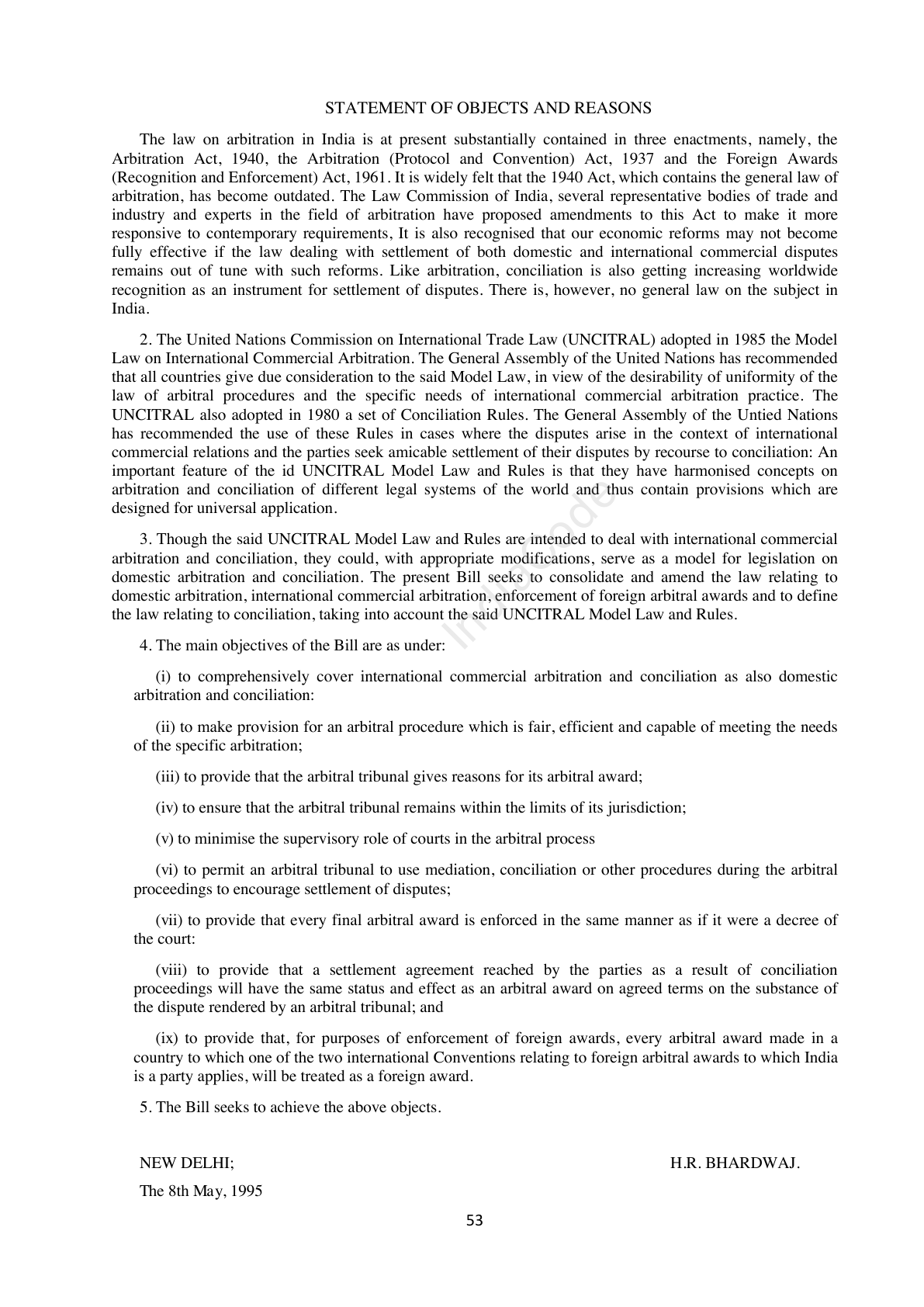
                                  STATEMENT OF OBJECTS AND REASONS
     The law on arbitration in India is at present substantially contained in three enactments, namely, the
Arbitration Act, 1940, the Arbitration (Protocol and Convention) Act, 1937 and the Foreign Awards
(Recognition and Enforcement) Act, 1961. It is widely felt that the 1940 Act, which contains the general law of
arbitration, has become outdated. The Law Commission of India, several representative bodies of trade and
industry and experts in the field of arbitration have proposed amendments to this Act to make it more
responsive to contemporary requirements, It is also recognised that our economic reforms may not become
fully effective if the law dealing with settlement of both domestic and international commercial disputes
remains out of tune with such reforms. Like arbitration, conciliation is also getting increasing worldwide
recognition as an instrument for settlement of disputes. There is, however, no general law on the subject in
India.
     2. The United Nations Commission on International Trade Law (UNCITRAL) adopted in 1985 the Model
Law on International Commercial Arbitration. The General Assembly of the United Nations has recommended
that all countries give due consideration to the said Model Law, in view of the desirability of uniformity of the
law of arbitral procedures and the specific needs of international commercial arbitration practice. The
UNCITRAL also adopted in 1980 a set of Conciliation Rules. The General Assembly of the Untied Nations
has recommended the use of these Rules in cases where the disputes arise in the context of international
commercial relations and the parties seek amicable settlement of their disputes by recourse to conciliation: An
important feature of the id UNCITRAL Model Law and Rules is that they have harmonised concepts on
arbitration and conciliation of different legal systems of the world and thus contain provisions which are
designed for universal application.                                       e
                                                                    od
     3. Though the said UNCITRAL Model Law and Rules are intended to deal with international commercial
arbitration and conciliation, they could, with appropriate modifications, serve as a model for legislation on
                                                              aC
domestic arbitration and conciliation. The present Bill seeks to consolidate and amend the law relating to
domestic arbitration, international commercial arbitration, enforcement of foreign arbitral awards and to define
                                                        di
the law relating to conciliation, taking into account the said UNCITRAL Model Law and Rules.
                                                   In
    4. The main objectives of the Bill are as under:
      (i) to comprehensively cover international commercial arbitration and conciliation as also domestic
   arbitration and conciliation:
       (ii) to make provision for an arbitral procedure which is fair, efficient and capable of meeting the needs
   of the specific arbitration;
      (iii) to provide that the arbitral tribunal gives reasons for its arbitral award;
      (iv) to ensure that the arbitral tribunal remains within the limits of its jurisdiction;
      (v) to minimise the supervisory role of courts in the arbitral process
      (vi) to permit an arbitral tribunal to use mediation, conciliation or other procedures during the arbitral
   proceedings to encourage settlement of disputes;
      (vii) to provide that every final arbitral award is enforced in the same manner as if it were a decree of
   the court:
      (viii) to provide that a settlement agreement reached by the parties as a result of conciliation
   proceedings will have the same status and effect as an arbitral award on agreed terms on the substance of
   the dispute rendered by an arbitral tribunal; and
       (ix) to provide that, for purposes of enforcement of foreign awards, every arbitral award made in a
   country to which one of the two international Conventions relating to foreign arbitral awards to which India
   is a party applies, will be treated as a foreign award.
    5. The Bill seeks to achieve the above objects.


    NEW DELHI;                                                                             H.R. BHARDWAJ.
    The 8th May, 1995
                                                         53
Compare original page image