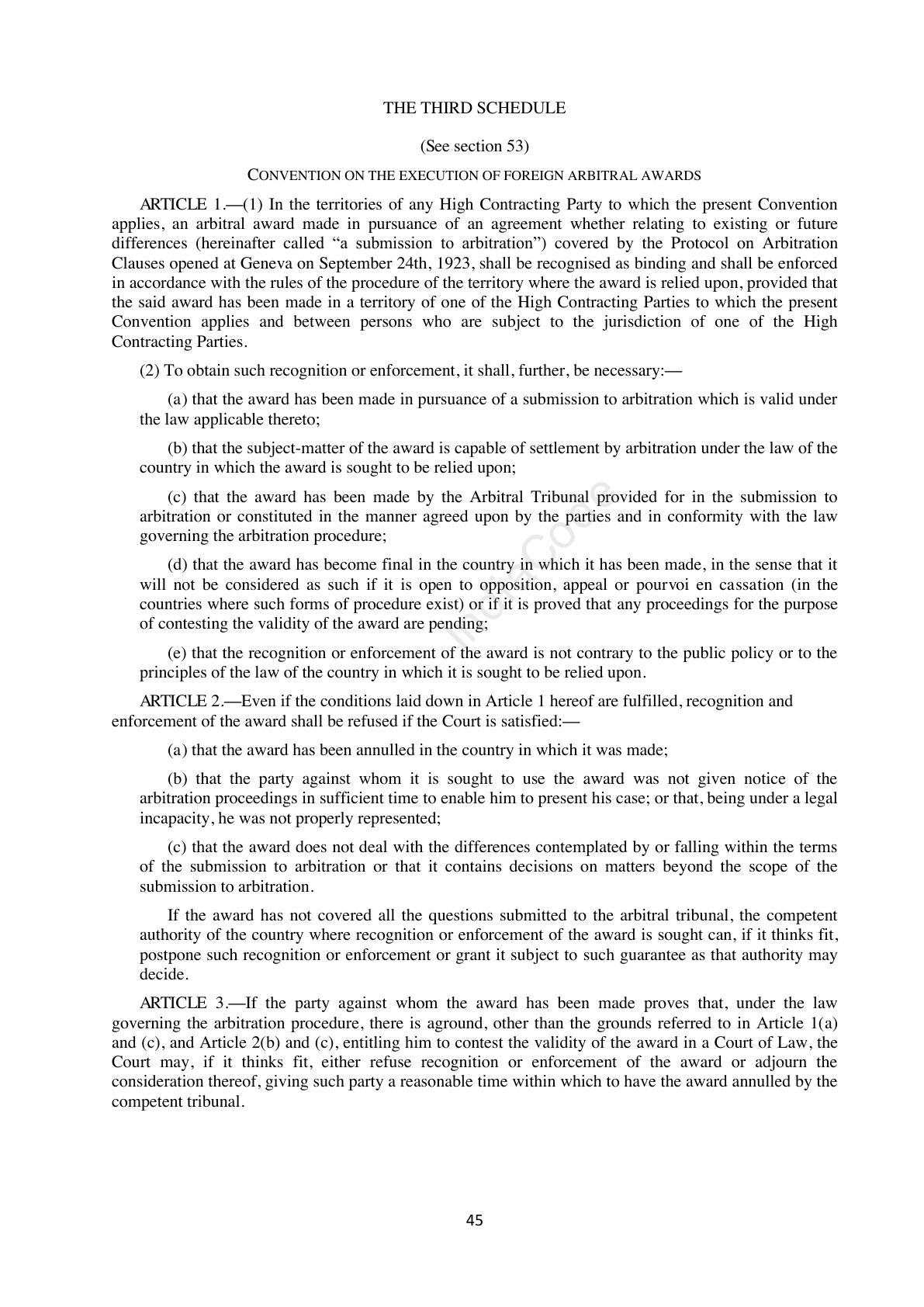
Full physical source page · unreviewed extraction
The Arbitration and Conciliation Act, 1996: page 45
The Arbitration and Conciliation Act, 1996, India Code delivered snapshot 6fb32e5ffe258174, physical page 45. Unreviewed extraction.
Source: official India Code PDF · catalog record. Fetched 2026-10-19T23:06:44Z. SHA-256 6fb32e5ffe2581740345d948c1e362bfbb5018ca7958932cde8ca92436485b6c.
Legal currency, territorial applicability and extraction fidelity are unverified. Catalog checksum/size differs from the delivered PDF; both identities are retained. Sections, state notes and footnotes share these physical pages. Compare the full original image.
Retained layout text
                                        THE THIRD SCHEDULE

                                              (See section 53)
                    CONVENTION ON THE EXECUTION OF FOREIGN ARBITRAL AWARDS
    ARTICLE 1.—(1) In the territories of any High Contracting Party to which the present Convention
applies, an arbitral award made in pursuance of an agreement whether relating to existing or future
differences (hereinafter called “a submission to arbitration”) covered by the Protocol on Arbitration
Clauses opened at Geneva on September 24th, 1923, shall be recognised as binding and shall be enforced
in accordance with the rules of the procedure of the territory where the award is relied upon, provided that
the said award has been made in a territory of one of the High Contracting Parties to which the present
Convention applies and between persons who are subject to the jurisdiction of one of the High
Contracting Parties.
    (2) To obtain such recognition or enforcement, it shall, further, be necessary:—
         (a) that the award has been made in pursuance of a submission to arbitration which is valid under
    the law applicable thereto;
       (b) that the subject-matter of the award is capable of settlement by arbitration under the law of the
    country in which the award is sought to be relied upon;
        (c) that the award has been made by the Arbitral Tribunal provided for in the submission to
                                                                     e
    arbitration or constituted in the manner agreed upon by the parties and in conformity with the law
    governing the arbitration procedure;                       od
                                                          aC
        (d) that the award has become final in the country in which it has been made, in the sense that it
    will not be considered as such if it is open to opposition, appeal or pourvoi en cassation (in the
                                                    di
    countries where such forms of procedure exist) or if it is proved that any proceedings for the purpose
    of contesting the validity of the award are pending;
                                               In
        (e) that the recognition or enforcement of the award is not contrary to the public policy or to the
    principles of the law of the country in which it is sought to be relied upon.
    ARTICLE 2.—Even if the conditions laid down in Article 1 hereof are fulfilled, recognition and
enforcement of the award shall be refused if the Court is satisfied:—
        (a) that the award has been annulled in the country in which it was made;
        (b) that the party against whom it is sought to use the award was not given notice of the
    arbitration proceedings in sufficient time to enable him to present his case; or that, being under a legal
    incapacity, he was not properly represented;
        (c) that the award does not deal with the differences contemplated by or falling within the terms
    of the submission to arbitration or that it contains decisions on matters beyond the scope of the
    submission to arbitration.
        If the award has not covered all the questions submitted to the arbitral tribunal, the competent
    authority of the country where recognition or enforcement of the award is sought can, if it thinks fit,
    postpone such recognition or enforcement or grant it subject to such guarantee as that authority may
    decide.
    ARTICLE 3.—If the party against whom the award has been made proves that, under the law
governing the arbitration procedure, there is aground, other than the grounds referred to in Article 1(a)
and (c), and Article 2(b) and (c), entitling him to contest the validity of the award in a Court of Law, the
Court may, if it thinks fit, either refuse recognition or enforcement of the award or adjourn the
consideration thereof, giving such party a reasonable time within which to have the award annulled by the
competent tribunal.


                                                     45
Compare original page image