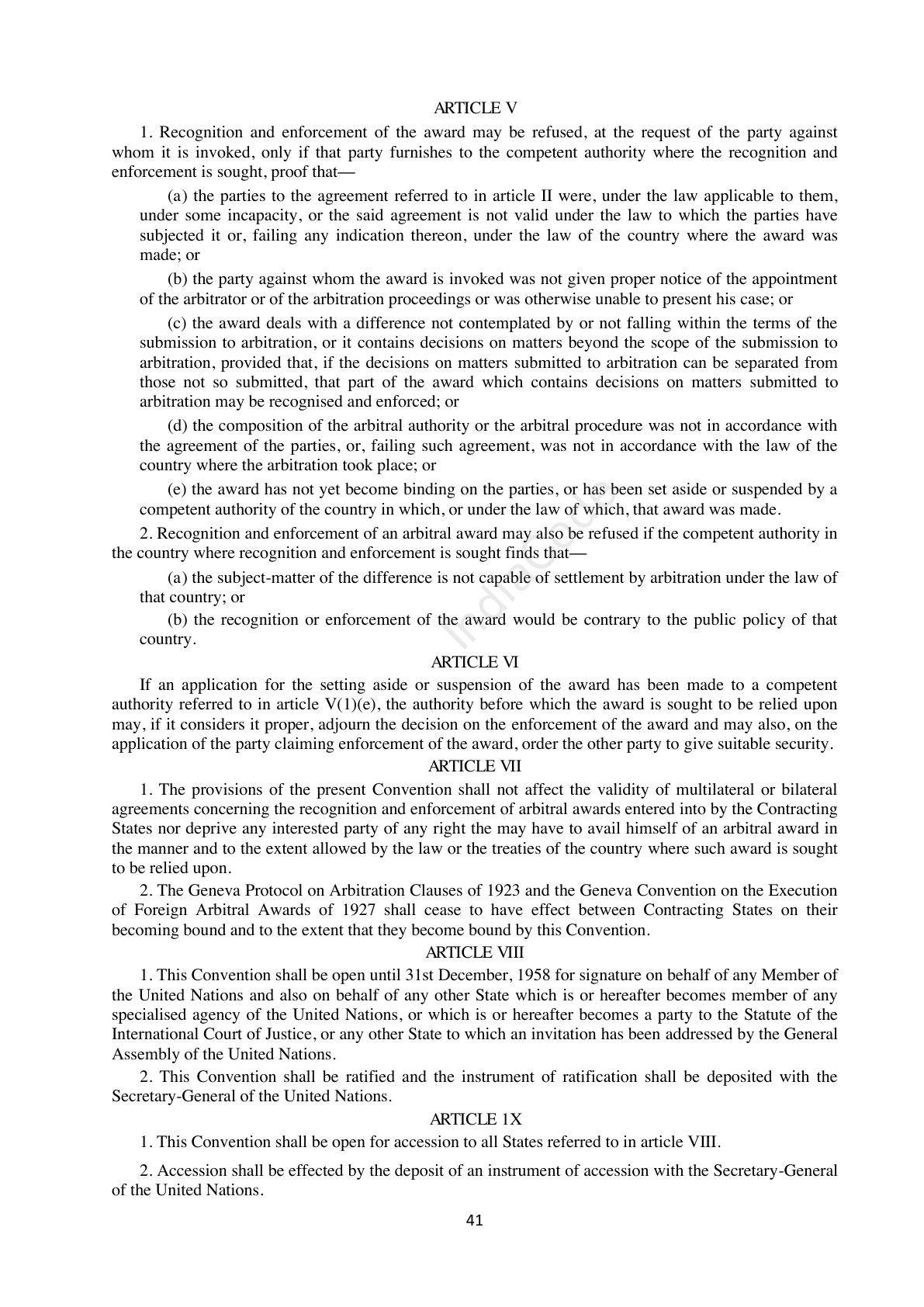
Full physical source page · unreviewed extraction
The Arbitration and Conciliation Act, 1996: page 41
The Arbitration and Conciliation Act, 1996, India Code delivered snapshot 6fb32e5ffe258174, physical page 41. Unreviewed extraction.
Source: official India Code PDF · catalog record. Fetched 2026-10-19T23:06:44Z. SHA-256 6fb32e5ffe2581740345d948c1e362bfbb5018ca7958932cde8ca92436485b6c.
Legal currency, territorial applicability and extraction fidelity are unverified. Catalog checksum/size differs from the delivered PDF; both identities are retained. Sections, state notes and footnotes share these physical pages. Compare the full original image.
Retained layout text
                                                  ARTICLE V
    1. Recognition and enforcement of the award may be refused, at the request of the party against
whom it is invoked, only if that party furnishes to the competent authority where the recognition and
enforcement is sought, proof that—
         (a) the parties to the agreement referred to in article II were, under the law applicable to them,
    under some incapacity, or the said agreement is not valid under the law to which the parties have
    subjected it or, failing any indication thereon, under the law of the country where the award was
    made; or
         (b) the party against whom the award is invoked was not given proper notice of the appointment
    of the arbitrator or of the arbitration proceedings or was otherwise unable to present his case; or
         (c) the award deals with a difference not contemplated by or not falling within the terms of the
    submission to arbitration, or it contains decisions on matters beyond the scope of the submission to
    arbitration, provided that, if the decisions on matters submitted to arbitration can be separated from
    those not so submitted, that part of the award which contains decisions on matters submitted to
    arbitration may be recognised and enforced; or
         (d) the composition of the arbitral authority or the arbitral procedure was not in accordance with
    the agreement of the parties, or, failing such agreement, was not in accordance with the law of the
    country where the arbitration took place; or
         (e) the award has not yet become binding on the parties, or has been set aside or suspended by a
                                                                     e
    competent authority of the country in which, or under the law of which, that award was made.
                                                               od
    2. Recognition and enforcement of an arbitral award may also be refused if the competent authority in
the country where recognition and enforcement is sought finds that—
                                                          aC
         (a) the subject-matter of the difference is not capable of settlement by arbitration under the law of
    that country; or                                di
         (b) the recognition or enforcement of the award would be contrary to the public policy of that
    country.                                   In
                                                  ARTICLE VI
    If an application for the setting aside or suspension of the award has been made to a competent
authority referred to in article V(1)(e), the authority before which the award is sought to be relied upon
may, if it considers it proper, adjourn the decision on the enforcement of the award and may also, on the
application of the party claiming enforcement of the award, order the other party to give suitable security.
                                                 ARTICLE VII
    1. The provisions of the present Convention shall not affect the validity of multilateral or bilateral
agreements concerning the recognition and enforcement of arbitral awards entered into by the Contracting
States nor deprive any interested party of any right the may have to avail himself of an arbitral award in
the manner and to the extent allowed by the law or the treaties of the country where such award is sought
to be relied upon.
    2. The Geneva Protocol on Arbitration Clauses of 1923 and the Geneva Convention on the Execution
of Foreign Arbitral Awards of 1927 shall cease to have effect between Contracting States on their
becoming bound and to the extent that they become bound by this Convention.
                                                 ARTICLE VIII
    1. This Convention shall be open until 31st December, 1958 for signature on behalf of any Member of
the United Nations and also on behalf of any other State which is or hereafter becomes member of any
specialised agency of the United Nations, or which is or hereafter becomes a party to the Statute of the
International Court of Justice, or any other State to which an invitation has been addressed by the General
Assembly of the United Nations.
    2. This Convention shall be ratified and the instrument of ratification shall be deposited with the
Secretary-General of the United Nations.
                                                 ARTICLE 1X
    1. This Convention shall be open for accession to all States referred to in article VIII.
     2. Accession shall be effected by the deposit of an instrument of accession with the Secretary-General
of the United Nations.
                                                     41
Compare original page image