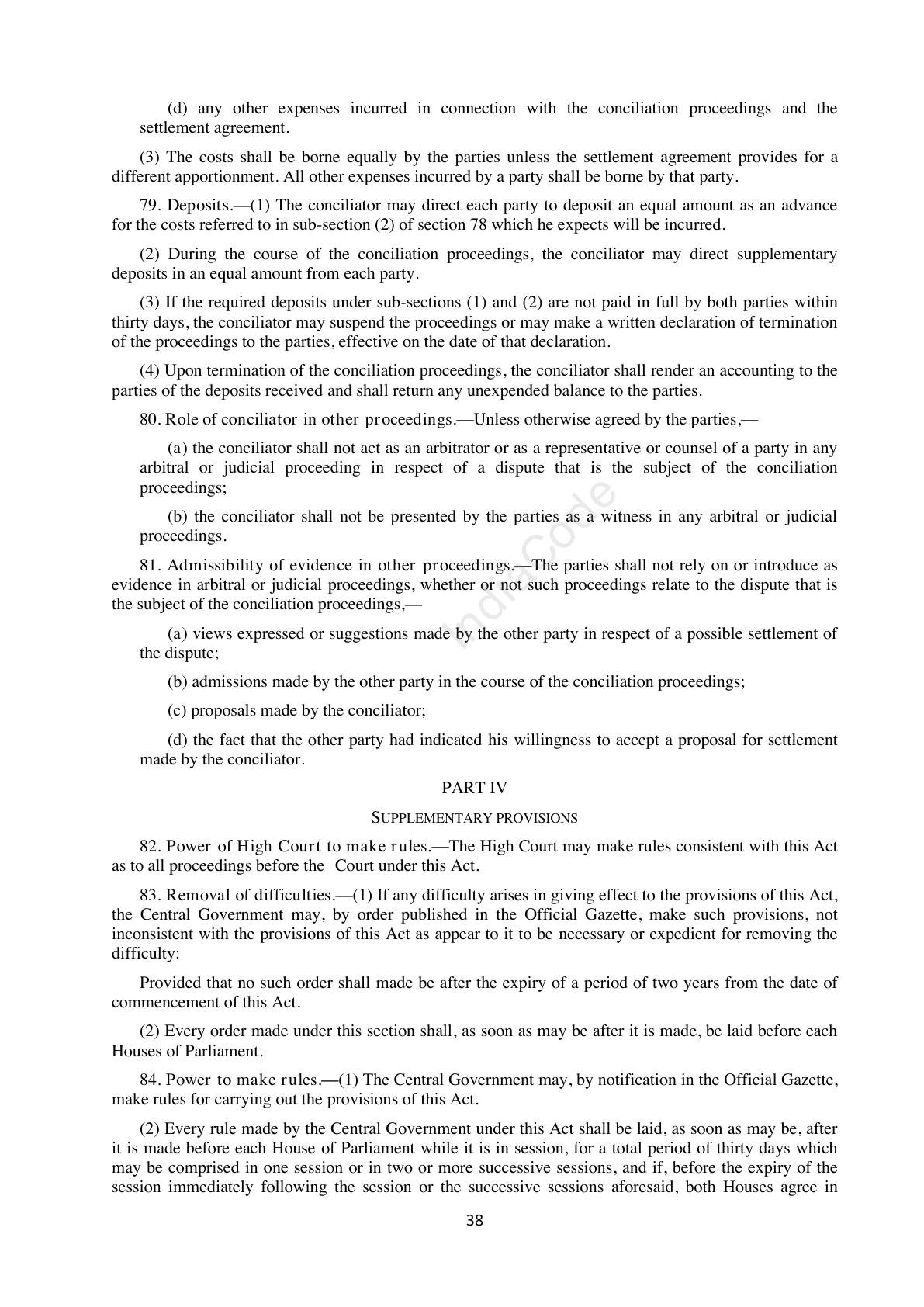
Full physical source page · unreviewed extraction
The Arbitration and Conciliation Act, 1996: page 38
The Arbitration and Conciliation Act, 1996, India Code delivered snapshot 6fb32e5ffe258174, physical page 38. Unreviewed extraction.
Source: official India Code PDF · catalog record. Fetched 2026-10-19T23:06:44Z. SHA-256 6fb32e5ffe2581740345d948c1e362bfbb5018ca7958932cde8ca92436485b6c.
Legal currency, territorial applicability and extraction fidelity are unverified. Catalog checksum/size differs from the delivered PDF; both identities are retained. Sections, state notes and footnotes share these physical pages. Compare the full original image.
Retained layout text
         (d) any other expenses incurred in connection with the conciliation proceedings and the
    settlement agreement.
    (3) The costs shall be borne equally by the parties unless the settlement agreement provides for a
different apportionment. All other expenses incurred by a party shall be borne by that party.
     79. Deposits.—(1) The conciliator may direct each party to deposit an equal amount as an advance
for the costs referred to in sub-section (2) of section 78 which he expects will be incurred.
   (2) During the course of the conciliation proceedings, the conciliator may direct supplementary
deposits in an equal amount from each party.
     (3) If the required deposits under sub-sections (1) and (2) are not paid in full by both parties within
thirty days, the conciliator may suspend the proceedings or may make a written declaration of termination
of the proceedings to the parties, effective on the date of that declaration.
    (4) Upon termination of the conciliation proceedings, the conciliator shall render an accounting to the
parties of the deposits received and shall return any unexpended balance to the parties.
    80. Role of conciliator in other proceedings.—Unless otherwise agreed by the parties,—
        (a) the conciliator shall not act as an arbitrator or as a representative or counsel of a party in any
    arbitral or judicial proceeding in respect of a dispute that is the subject of the conciliation
    proceedings;
                                                                     e
        (b) the conciliator shall not be presented by the parties as a witness in any arbitral or judicial
    proceedings.                                               od
                                                          aC
    81. Admissibility of evidence in other proceedings.—The parties shall not rely on or introduce as
evidence in arbitral or judicial proceedings, whether or not such proceedings relate to the dispute that is
the subject of the conciliation proceedings,—       di
                                                 In
        (a) views expressed or suggestions made by the other party in respect of a possible settlement of
    the dispute;
        (b) admissions made by the other party in the course of the conciliation proceedings;
        (c) proposals made by the conciliator;
       (d) the fact that the other party had indicated his willingness to accept a proposal for settlement
    made by the conciliator.
                                                  PART IV
                                       SUPPLEMENTARY PROVISIONS
     82. Power of High Court to make rules.—The High Court may make rules consistent with this Act
as to all proceedings before the Court under this Act.
     83. Removal of difficulties.—(1) If any difficulty arises in giving effect to the provisions of this Act,
the Central Government may, by order published in the Official Gazette, make such provisions, not
inconsistent with the provisions of this Act as appear to it to be necessary or expedient for removing the
difficulty:
   Provided that no such order shall made be after the expiry of a period of two years from the date of
commencement of this Act.
   (2) Every order made under this section shall, as soon as may be after it is made, be laid before each
Houses of Parliament.
   84. Power to make rules.—(1) The Central Government may, by notification in the Official Gazette,
make rules for carrying out the provisions of this Act.
     (2) Every rule made by the Central Government under this Act shall be laid, as soon as may be, after
it is made before each House of Parliament while it is in session, for a total period of thirty days which
may be comprised in one session or in two or more successive sessions, and if, before the expiry of the
session immediately following the session or the successive sessions aforesaid, both Houses agree in
                                                     38
Compare original page image