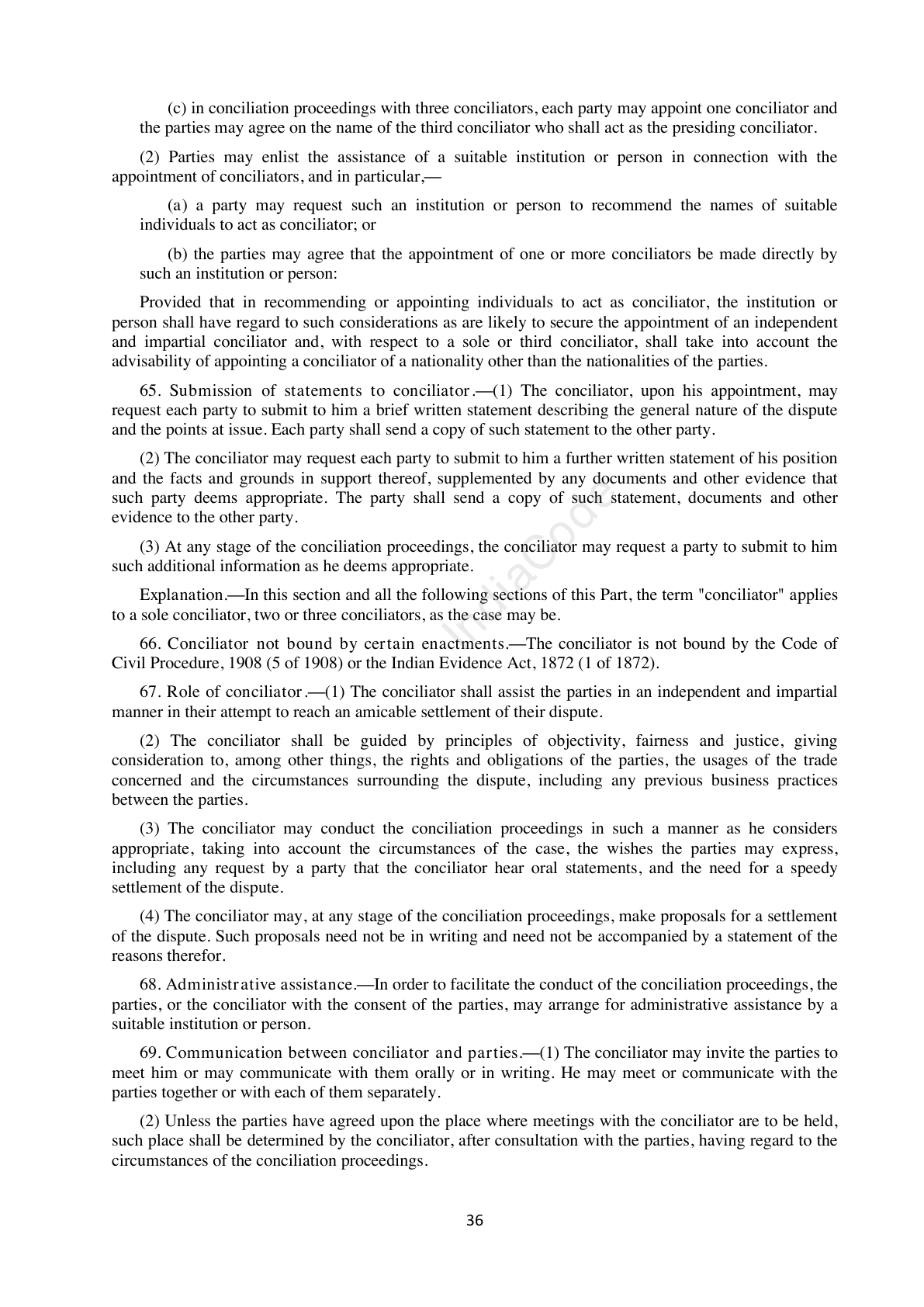
Full physical source page · unreviewed extraction
The Arbitration and Conciliation Act, 1996: page 36
The Arbitration and Conciliation Act, 1996, India Code delivered snapshot 6fb32e5ffe258174, physical page 36. Unreviewed extraction.
Source: official India Code PDF · catalog record. Fetched 2026-10-19T23:06:44Z. SHA-256 6fb32e5ffe2581740345d948c1e362bfbb5018ca7958932cde8ca92436485b6c.
Legal currency, territorial applicability and extraction fidelity are unverified. Catalog checksum/size differs from the delivered PDF; both identities are retained. Sections, state notes and footnotes share these physical pages. Compare the full original image.
Retained layout text
        (c) in conciliation proceedings with three conciliators, each party may appoint one conciliator and
    the parties may agree on the name of the third conciliator who shall act as the presiding conciliator.
   (2) Parties may enlist the assistance of a suitable institution or person in connection with the
appointment of conciliators, and in particular,—
        (a) a party may request such an institution or person to recommend the names of suitable
    individuals to act as conciliator; or
        (b) the parties may agree that the appointment of one or more conciliators be made directly by
    such an institution or person:
    Provided that in recommending or appointing individuals to act as conciliator, the institution or
person shall have regard to such considerations as are likely to secure the appointment of an independent
and impartial conciliator and, with respect to a sole or third conciliator, shall take into account the
advisability of appointing a conciliator of a nationality other than the nationalities of the parties.
    65. Submission of statements to conciliator.—(1) The conciliator, upon his appointment, may
request each party to submit to him a brief written statement describing the general nature of the dispute
and the points at issue. Each party shall send a copy of such statement to the other party.
    (2) The conciliator may request each party to submit to him a further written statement of his position
and the facts and grounds in support thereof, supplemented by any documents and other evidence that
such party deems appropriate. The party shall send a copy of such statement, documents and other
                                                                    e
evidence to the other party.
                                                              od
    (3) At any stage of the conciliation proceedings, the conciliator may request a party to submit to him
such additional information as he deems appropriate.      aC
     Explanation.—In this section and all the following sections of this Part, the term "conciliator" applies
                                                   di
to a sole conciliator, two or three conciliators, as the case may be.
                                               In
    66. Conciliator not bound by certain enactments.—The conciliator is not bound by the Code of
Civil Procedure, 1908 (5 of 1908) or the Indian Evidence Act, 1872 (1 of 1872).
   67. Role of conciliator.—(1) The conciliator shall assist the parties in an independent and impartial
manner in their attempt to reach an amicable settlement of their dispute.
    (2) The conciliator shall be guided by principles of objectivity, fairness and justice, giving
consideration to, among other things, the rights and obligations of the parties, the usages of the trade
concerned and the circumstances surrounding the dispute, including any previous business practices
between the parties.
     (3) The conciliator may conduct the conciliation proceedings in such a manner as he considers
appropriate, taking into account the circumstances of the case, the wishes the parties may express,
including any request by a party that the conciliator hear oral statements, and the need for a speedy
settlement of the dispute.
    (4) The conciliator may, at any stage of the conciliation proceedings, make proposals for a settlement
of the dispute. Such proposals need not be in writing and need not be accompanied by a statement of the
reasons therefor.
    68. Administrative assistance.—In order to facilitate the conduct of the conciliation proceedings, the
parties, or the conciliator with the consent of the parties, may arrange for administrative assistance by a
suitable institution or person.
    69. Communication between conciliator and parties.—(1) The conciliator may invite the parties to
meet him or may communicate with them orally or in writing. He may meet or communicate with the
parties together or with each of them separately.
    (2) Unless the parties have agreed upon the place where meetings with the conciliator are to be held,
such place shall be determined by the conciliator, after consultation with the parties, having regard to the
circumstances of the conciliation proceedings.


                                                     36
Compare original page image