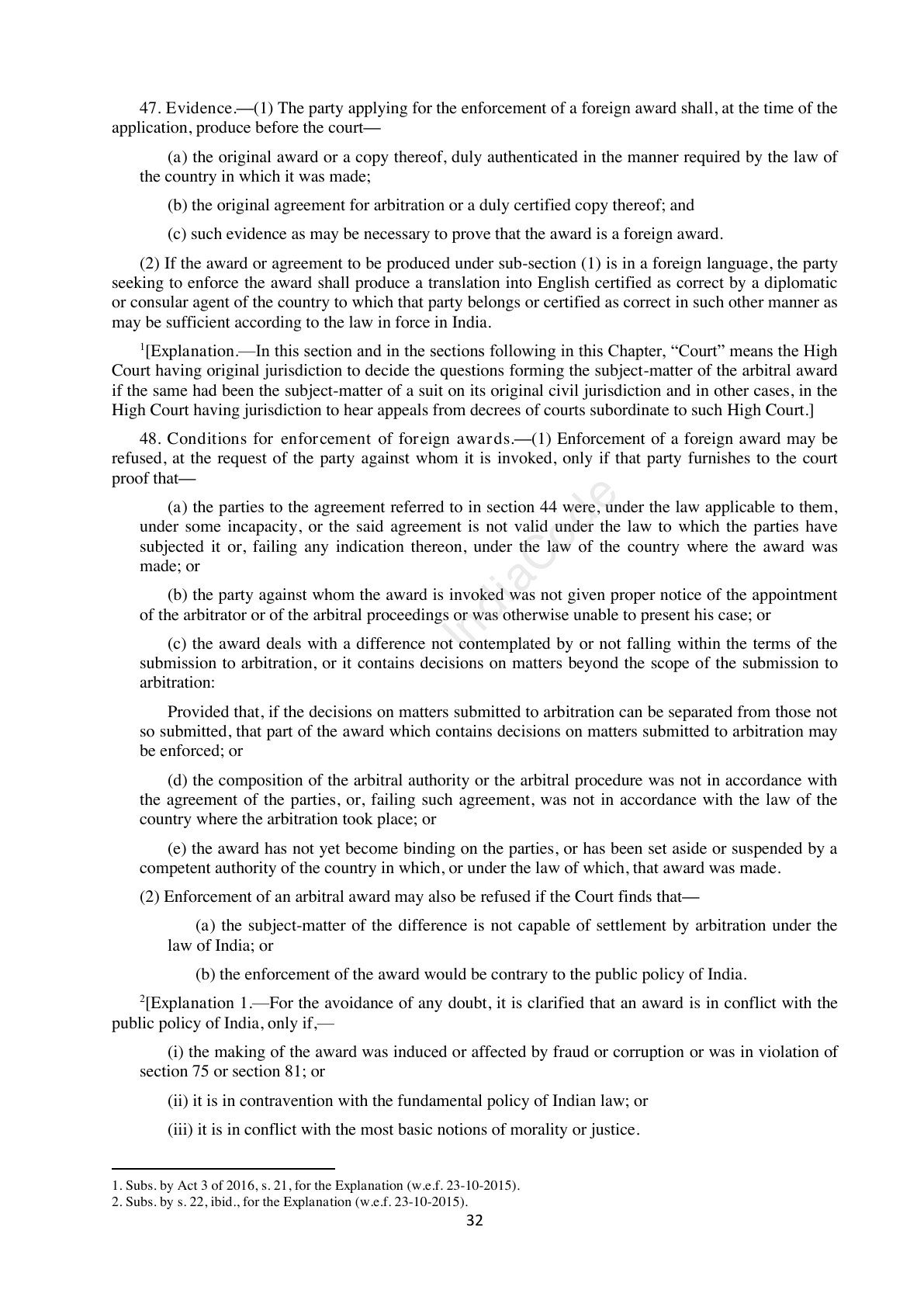
Full physical source page · unreviewed extraction
The Arbitration and Conciliation Act, 1996: page 32
The Arbitration and Conciliation Act, 1996, India Code delivered snapshot 6fb32e5ffe258174, physical page 32. Unreviewed extraction.
Source: official India Code PDF · catalog record. Fetched 2026-10-19T23:06:44Z. SHA-256 6fb32e5ffe2581740345d948c1e362bfbb5018ca7958932cde8ca92436485b6c.
Legal currency, territorial applicability and extraction fidelity are unverified. Catalog checksum/size differs from the delivered PDF; both identities are retained. Sections, state notes and footnotes share these physical pages. Compare the full original image.
Retained layout text
    47. Evidence.—(1) The party applying for the enforcement of a foreign award shall, at the time of the
application, produce before the court—
         (a) the original award or a copy thereof, duly authenticated in the manner required by the law of
     the country in which it was made;
          (b) the original agreement for arbitration or a duly certified copy thereof; and
          (c) such evidence as may be necessary to prove that the award is a foreign award.
    (2) If the award or agreement to be produced under sub-section (1) is in a foreign language, the party
seeking to enforce the award shall produce a translation into English certified as correct by a diplomatic
or consular agent of the country to which that party belongs or certified as correct in such other manner as
may be sufficient according to the law in force in India.
     1
      [Explanation.—In this section and in the sections following in this Chapter, “Court” means the High
Court having original jurisdiction to decide the questions forming the subject-matter of the arbitral award
if the same had been the subject-matter of a suit on its original civil jurisdiction and in other cases, in the
High Court having jurisdiction to hear appeals from decrees of courts subordinate to such High Court.]
    48. Conditions for enforcement of foreign awards.—(1) Enforcement of a foreign award may be
refused, at the request of the party against whom it is invoked, only if that party furnishes to the court
proof that—
                                                                              e
         (a) the parties to the agreement referred to in section 44 were, under the law applicable to them,
                                                                             od
     under some incapacity, or the said agreement is not valid under the law to which the parties have
     subjected it or, failing any indication thereon, under the law of the country where the award was
     made; or                                                        aC
          (b) the party against whom the award is invoked was not given proper notice of the appointment
                                                              di
     of the arbitrator or of the arbitral proceedings or was otherwise unable to present his case; or
                                                         In
         (c) the award deals with a difference not contemplated by or not falling within the terms of the
     submission to arbitration, or it contains decisions on matters beyond the scope of the submission to
     arbitration:
         Provided that, if the decisions on matters submitted to arbitration can be separated from those not
     so submitted, that part of the award which contains decisions on matters submitted to arbitration may
     be enforced; or
         (d) the composition of the arbitral authority or the arbitral procedure was not in accordance with
     the agreement of the parties, or, failing such agreement, was not in accordance with the law of the
     country where the arbitration took place; or
        (e) the award has not yet become binding on the parties, or has been set aside or suspended by a
     competent authority of the country in which, or under the law of which, that award was made.
     (2) Enforcement of an arbitral award may also be refused if the Court finds that—
              (a) the subject-matter of the difference is not capable of settlement by arbitration under the
          law of India; or
               (b) the enforcement of the award would be contrary to the public policy of India.
     2
     [Explanation 1.—For the avoidance of any doubt, it is clarified that an award is in conflict with the
public policy of India, only if,—
         (i) the making of the award was induced or affected by fraud or corruption or was in violation of
     section 75 or section 81; or
          (ii) it is in contravention with the fundamental policy of Indian law; or
          (iii) it is in conflict with the most basic notions of morality or justice.


1. Subs. by Act 3 of 2016, s. 21, for the Explanation (w.e.f. 23-10-2015).
2. Subs. by s. 22, ibid., for the Explanation (w.e.f. 23-10-2015).
                                                                32
Compare original page image