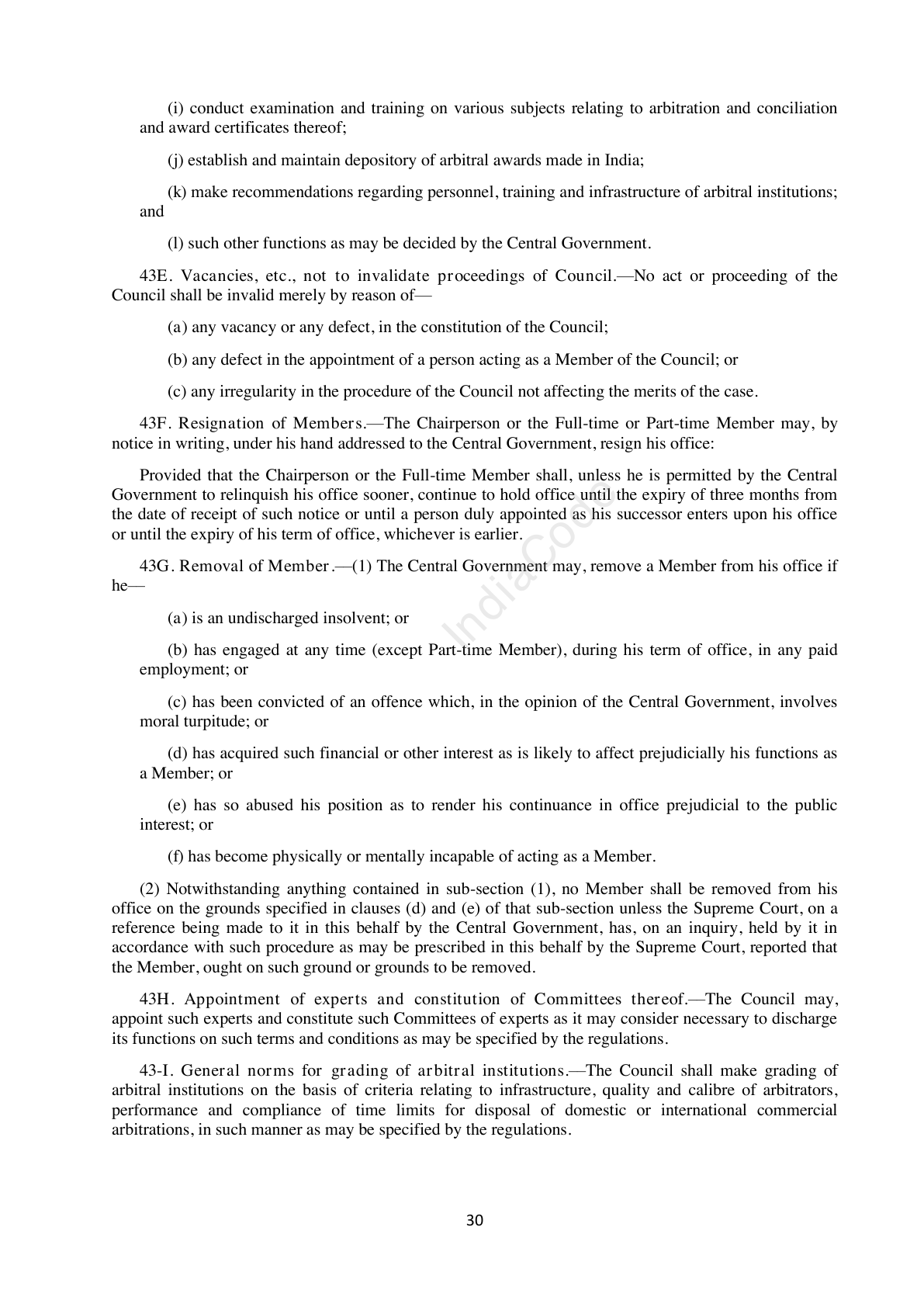
Full physical source page · unreviewed extraction
The Arbitration and Conciliation Act, 1996: page 30
The Arbitration and Conciliation Act, 1996, India Code delivered snapshot 6fb32e5ffe258174, physical page 30. Unreviewed extraction.
Source: official India Code PDF · catalog record. Fetched 2026-10-19T23:06:44Z. SHA-256 6fb32e5ffe2581740345d948c1e362bfbb5018ca7958932cde8ca92436485b6c.
Legal currency, territorial applicability and extraction fidelity are unverified. Catalog checksum/size differs from the delivered PDF; both identities are retained. Sections, state notes and footnotes share these physical pages. Compare the full original image.
Retained layout text
        (i) conduct examination and training on various subjects relating to arbitration and conciliation
    and award certificates thereof;
          (j) establish and maintain depository of arbitral awards made in India;
          (k) make recommendations regarding personnel, training and infrastructure of arbitral institutions;
    and
          (l) such other functions as may be decided by the Central Government.
   43E. Vacancies, etc., not to invalidate proceedings of Council.—No act or proceeding of the
Council shall be invalid merely by reason of—
          (a) any vacancy or any defect, in the constitution of the Council;
          (b) any defect in the appointment of a person acting as a Member of the Council; or
          (c) any irregularity in the procedure of the Council not affecting the merits of the case.
    43F. Resignation of Members.—The Chairperson or the Full-time or Part-time Member may, by
notice in writing, under his hand addressed to the Central Government, resign his office:
    Provided that the Chairperson or the Full-time Member shall, unless he is permitted by the Central
Government to relinquish his office sooner, continue to hold office until the expiry of three months from
                                                                       e
the date of receipt of such notice or until a person duly appointed as his successor enters upon his office
or until the expiry of his term of office, whichever is earlier. od
                                                            aC
   43G. Removal of Member.––(1) The Central Government may, remove a Member from his office if
he––
          (a) is an undischarged insolvent; or
                                                      di
                                                 In
       (b) has engaged at any time (except Part-time Member), during his term of office, in any paid
    employment; or
       (c) has been convicted of an offence which, in the opinion of the Central Government, involves
    moral turpitude; or
       (d) has acquired such financial or other interest as is likely to affect prejudicially his functions as
    a Member; or
        (e) has so abused his position as to render his continuance in office prejudicial to the public
    interest; or
          (f) has become physically or mentally incapable of acting as a Member.
    (2) Notwithstanding anything contained in sub-section (1), no Member shall be removed from his
office on the grounds specified in clauses (d) and (e) of that sub-section unless the Supreme Court, on a
reference being made to it in this behalf by the Central Government, has, on an inquiry, held by it in
accordance with such procedure as may be prescribed in this behalf by the Supreme Court, reported that
the Member, ought on such ground or grounds to be removed.
     43H. Appointment of experts and constitution of Committees thereof.––The Council may,
appoint such experts and constitute such Committees of experts as it may consider necessary to discharge
its functions on such terms and conditions as may be specified by the regulations.
    43-I. General norms for grading of arbitral institutions.––The Council shall make grading of
arbitral institutions on the basis of criteria relating to infrastructure, quality and calibre of arbitrators,
performance and compliance of time limits for disposal of domestic or international commercial
arbitrations, in such manner as may be specified by the regulations.


                                                       30
Compare original page image