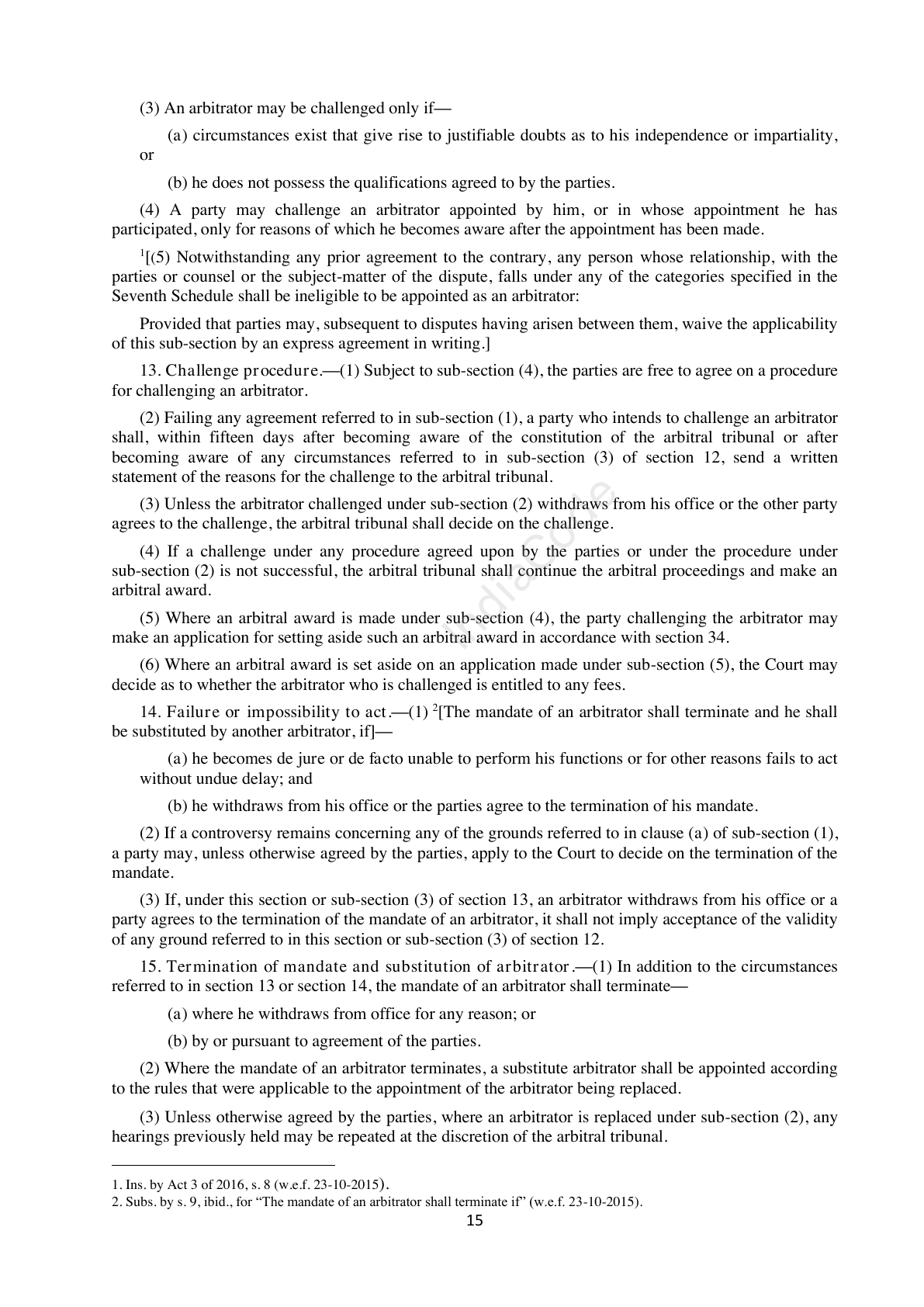
Full physical source page · unreviewed extraction
The Arbitration and Conciliation Act, 1996: page 15
The Arbitration and Conciliation Act, 1996, India Code delivered snapshot 6fb32e5ffe258174, physical page 15. Unreviewed extraction.
Source: official India Code PDF · catalog record. Fetched 2026-10-19T23:06:44Z. SHA-256 6fb32e5ffe2581740345d948c1e362bfbb5018ca7958932cde8ca92436485b6c.
Legal currency, territorial applicability and extraction fidelity are unverified. Catalog checksum/size differs from the delivered PDF; both identities are retained. Sections, state notes and footnotes share these physical pages. Compare the full original image.
Retained layout text
     (3) An arbitrator may be challenged only if—
          (a) circumstances exist that give rise to justifiable doubts as to his independence or impartiality,
     or
          (b) he does not possess the qualifications agreed to by the parties.
    (4) A party may challenge an arbitrator appointed by him, or in whose appointment he has
participated, only for reasons of which he becomes aware after the appointment has been made.
     1
     [(5) Notwithstanding any prior agreement to the contrary, any person whose relationship, with the
parties or counsel or the subject-matter of the dispute, falls under any of the categories specified in the
Seventh Schedule shall be ineligible to be appointed as an arbitrator:
     Provided that parties may, subsequent to disputes having arisen between them, waive the applicability
of this sub-section by an express agreement in writing.]
    13. Challenge procedure.—(1) Subject to sub-section (4), the parties are free to agree on a procedure
for challenging an arbitrator.
     (2) Failing any agreement referred to in sub-section (1), a party who intends to challenge an arbitrator
shall, within fifteen days after becoming aware of the constitution of the arbitral tribunal or after
becoming aware of any circumstances referred to in sub-section (3) of section 12, send a written
statement of the reasons for the challenge to the arbitral tribunal.
                                                                                     e
    (3) Unless the arbitrator challenged under sub-section (2) withdraws from his office or the other party
agrees to the challenge, the arbitral tribunal shall decide on the challenge.od
    (4) If a challenge under any procedure agreed upon by the parties or under the procedure under
                                                                       aC
sub-section (2) is not successful, the arbitral tribunal shall continue the arbitral proceedings and make an
arbitral award.
                                                                di
   (5) Where an arbitral award is made under sub-section (4), the party challenging the arbitrator may
                                                           In
make an application for setting aside such an arbitral award in accordance with section 34.
    (6) Where an arbitral award is set aside on an application made under sub-section (5), the Court may
decide as to whether the arbitrator who is challenged is entitled to any fees.
    14. Failure or impossibility to act.—(1) 2[The mandate of an arbitrator shall terminate and he shall
be substituted by another arbitrator, if]—
         (a) he becomes de jure or de facto unable to perform his functions or for other reasons fails to act
     without undue delay; and
          (b) he withdraws from his office or the parties agree to the termination of his mandate.
    (2) If a controversy remains concerning any of the grounds referred to in clause (a) of sub-section (1),
a party may, unless otherwise agreed by the parties, apply to the Court to decide on the termination of the
mandate.
    (3) If, under this section or sub-section (3) of section 13, an arbitrator withdraws from his office or a
party agrees to the termination of the mandate of an arbitrator, it shall not imply acceptance of the validity
of any ground referred to in this section or sub-section (3) of section 12.
    15. Termination of mandate and substitution of arbitrator.—(1) In addition to the circumstances
referred to in section 13 or section 14, the mandate of an arbitrator shall terminate—
          (a) where he withdraws from office for any reason; or
          (b) by or pursuant to agreement of the parties.
     (2) Where the mandate of an arbitrator terminates, a substitute arbitrator shall be appointed according
to the rules that were applicable to the appointment of the arbitrator being replaced.
    (3) Unless otherwise agreed by the parties, where an arbitrator is replaced under sub-section (2), any
hearings previously held may be repeated at the discretion of the arbitral tribunal.

1. Ins. by Act 3 of 2016, s. 8 (w.e.f. 23-10-2015).
2. Subs. by s. 9, ibid., for “The mandate of an arbitrator shall terminate if” (w.e.f. 23-10-2015).
                                                                  15
Compare original page image