The Maharashtra Shops and Establishments (Regulation of Employment and Conditions of Service) Act, 2017 — Physical PDF page 16 of 18
Unreviewed source-only snapshot. Full pages may contain principal wording, editorial commentary, tables, footnotes and appended documentary material. This is not approved current law or a purified section corpus.
Catalogue jurisdiction: Maharashtra; territorial applicability is unverified.
- Page 4 is sparse running header/watermark only (24 extracted words); retain as source page rather than deleting it.
- Printed Text as on 31 December 2025 is a publisher label; page 3 lists 2022/2025 amendments and later notes cite Mah.56 of 2025. No newer-currentness claim.
- Lettered 31A/31B and amendment footnotes must not be lost by a numbered-heading scanner.
- Delivered/catalogue checksum and size discrepancies remain unresolved; no currentness, legal-text fidelity or human approval.
Download complete pinned PDF · All physical pages
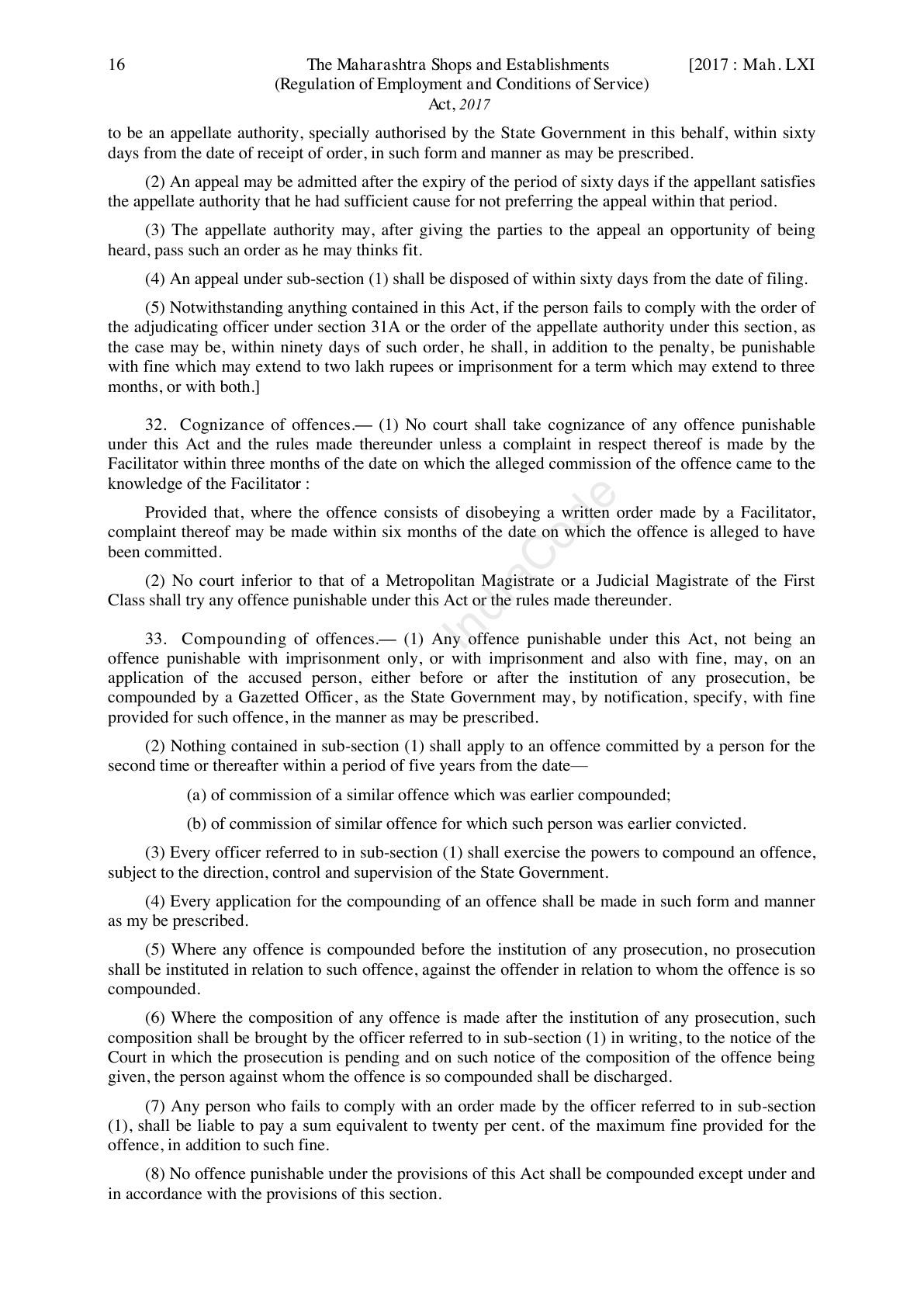
Unreviewed complete page layout text
16                           The Maharashtra Shops and Establishments                  [2017 : Mah. LXI
                         (Regulation of Employment and Conditions of Service)
                                              Act, 2017
to be an appellate authority, specially authorised by the State Government in this behalf, within sixty
days from the date of receipt of order, in such form and manner as may be prescribed.
      (2) An appeal may be admitted after the expiry of the period of sixty days if the appellant satisfies
the appellate authority that he had sufficient cause for not preferring the appeal within that period.
     (3) The appellate authority may, after giving the parties to the appeal an opportunity of being
heard, pass such an order as he may thinks fit.
     (4) An appeal under sub-section (1) shall be disposed of within sixty days from the date of filing.
     (5) Notwithstanding anything contained in this Act, if the person fails to comply with the order of
the adjudicating officer under section 31A or the order of the appellate authority under this section, as
the case may be, within ninety days of such order, he shall, in addition to the penalty, be punishable
with fine which may extend to two lakh rupees or imprisonment for a term which may extend to three
months, or with both.]

      32. Cognizance of offences.— (1) No court shall take cognizance of any offence punishable
under this Act and the rules made thereunder unless a complaint in respect thereof is made by the
Facilitator within three months of the date on which the alleged commission of the offence came to the
knowledge of the Facilitator :
                                                                     e
     Provided that, where the offence consists of disobeying a written order made by a Facilitator,
                                                               od
complaint thereof may be made within six months of the date on which the offence is alleged to have
been committed.
                                                         aC
     (2) No court inferior to that of a Metropolitan Magistrate or a Judicial Magistrate of the First
Class shall try any offence punishable under this Act or the rules made thereunder.
                                                    di
                                                In
     33. Compounding of offences.— (1) Any offence punishable under this Act, not being an
offence punishable with imprisonment only, or with imprisonment and also with fine, may, on an
application of the accused person, either before or after the institution of any prosecution, be
compounded by a Gazetted Officer, as the State Government may, by notification, specify, with fine
provided for such offence, in the manner as may be prescribed.
     (2) Nothing contained in sub-section (1) shall apply to an offence committed by a person for the
second time or thereafter within a period of five years from the date—
           (a) of commission of a similar offence which was earlier compounded;
           (b) of commission of similar offence for which such person was earlier convicted.
     (3) Every officer referred to in sub-section (1) shall exercise the powers to compound an offence,
subject to the direction, control and supervision of the State Government.
     (4) Every application for the compounding of an offence shall be made in such form and manner
as my be prescribed.
      (5) Where any offence is compounded before the institution of any prosecution, no prosecution
shall be instituted in relation to such offence, against the offender in relation to whom the offence is so
compounded.
     (6) Where the composition of any offence is made after the institution of any prosecution, such
composition shall be brought by the officer referred to in sub-section (1) in writing, to the notice of the
Court in which the prosecution is pending and on such notice of the composition of the offence being
given, the person against whom the offence is so compounded shall be discharged.
      (7) Any person who fails to comply with an order made by the officer referred to in sub-section
(1), shall be liable to pay a sum equivalent to twenty per cent. of the maximum fine provided for the
offence, in addition to such fine.
      (8) No offence punishable under the provisions of this Act shall be compounded except under and
in accordance with the provisions of this section.