The Goa Shops and Establishments Act, 1973 — Physical PDF page 16 of 23
Unreviewed source-only snapshot. Full pages may contain principal wording, editorial commentary, tables, footnotes and appended documentary material. This is not approved current law or a purified section corpus.
Catalogue jurisdiction: Goa; territorial applicability is unverified.
- Title is 1973, printed Act number is 13 of 1974; cover notification LD/Bill/9/74 prints assent 28 September 1973 and publication 24 October 1974. Preserve all labels without reconciling them.
- Goa/Daman/Diu historical territorial wording and trailing numbered amendment notes on page 23 must remain.
- Separate 2025 Shops Act is not this edition; no repeal/currentness inference from the older title.
- Delivered/catalogue checksum and size discrepancies remain unresolved; no currentness, legal-text fidelity or human approval.
Download complete pinned PDF · All physical pages
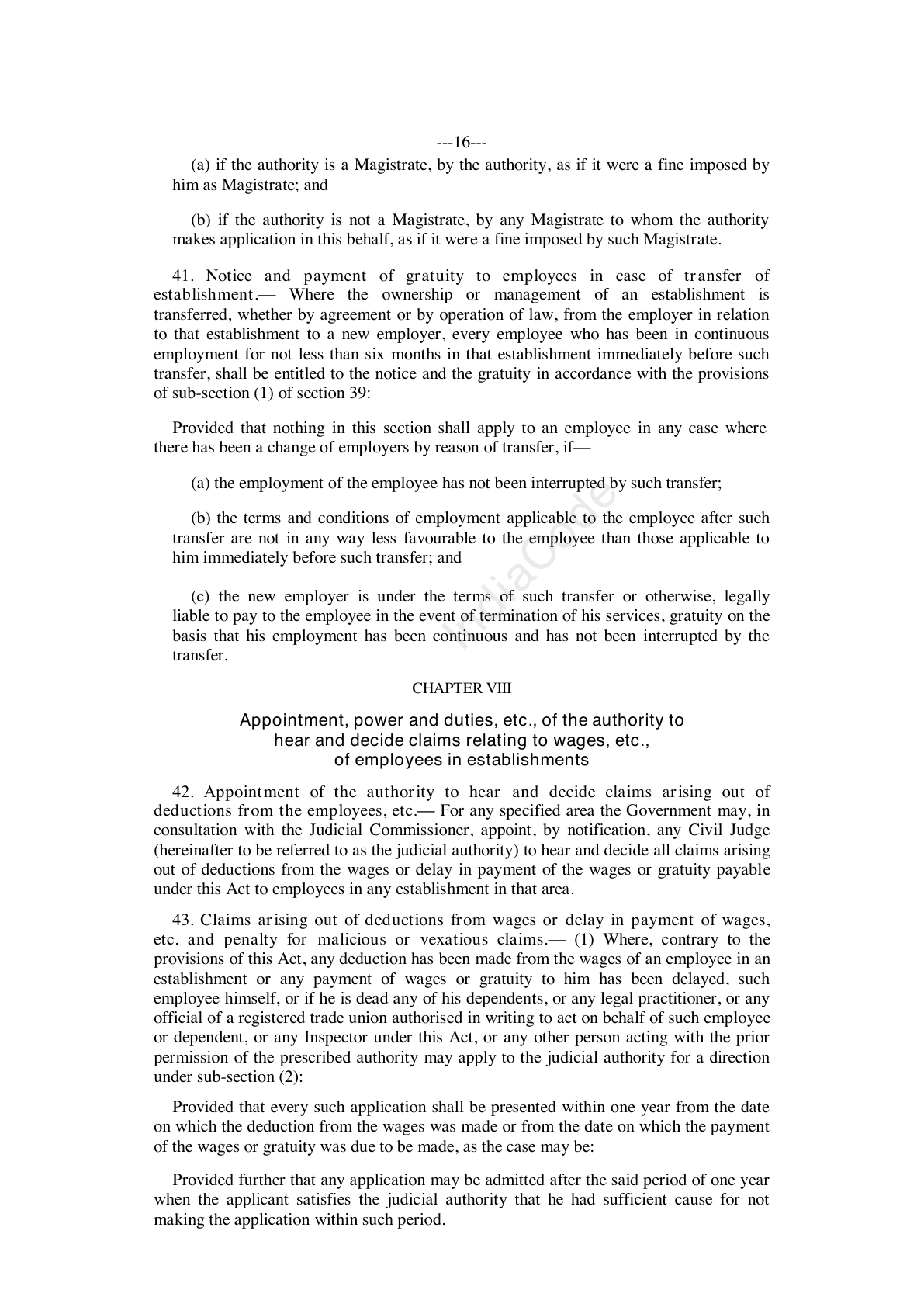
Unreviewed complete page layout text
                                          ---16---
    (a) if the authority is a Magistrate, by the authority, as if it were a fine imposed by
  him as Magistrate; and

    (b) if the authority is not a Magistrate, by any Magistrate to whom the authority
  makes application in this behalf, as if it were a fine imposed by such Magistrate.

   41. Notice and payment of gratuity to employees in case of transfer of
establishment.— Where the ownership or management of an establishment is
transferred, whether by agreement or by operation of law, from the employer in relation
to that establishment to a new employer, every employee who has been in continuous
employment for not less than six months in that establishment immediately before such
transfer, shall be entitled to the notice and the gratuity in accordance with the provisions
of sub-section (1) of section 39:

   Provided that nothing in this section shall apply to an employee in any case where
there has been a change of employers by reason of transfer, if—

     (a) the employment of the employee has not been interrupted by such transfer;
                                                               e
     (b) the terms and conditions of employment applicable to the employee after such
                                                         od
  transfer are not in any way less favourable to the employee than those applicable to
  him immediately before such transfer; and
                                                   aC
     (c) the new employer is under the terms of such transfer or otherwise, legally
                                              di
  liable to pay to the employee in the event of termination of his services, gratuity on the
                                          In
  basis that his employment has been continuous and has not been interrupted by the
  transfer.
                                       CHAPTER VIII

             Appointment, power and duties, etc., of the authority to
                hear and decide claims relating to wages, etc.,
                       of employees in establishments
   42. Appointment of the authority to hear and decide claims arising out of
deductions from the employees, etc.— For any specified area the Government may, in
consultation with the Judicial Commissioner, appoint, by notification, any Civil Judge
(hereinafter to be referred to as the judicial authority) to hear and decide all claims arising
out of deductions from the wages or delay in payment of the wages or gratuity payable
under this Act to employees in any establishment in that area.
   43. Claims arising out of deductions from wages or delay in payment of wages,
etc. and penalty for malicious or vexatious claims.— (1) Where, contrary to the
provisions of this Act, any deduction has been made from the wages of an employee in an
establishment or any payment of wages or gratuity to him has been delayed, such
employee himself, or if he is dead any of his dependents, or any legal practitioner, or any
official of a registered trade union authorised in writing to act on behalf of such employee
or dependent, or any Inspector under this Act, or any other person acting with the prior
permission of the prescribed authority may apply to the judicial authority for a direction
under sub-section (2):
   Provided that every such application shall be presented within one year from the date
on which the deduction from the wages was made or from the date on which the payment
of the wages or gratuity was due to be made, as the case may be:
  Provided further that any application may be admitted after the said period of one year
when the applicant satisfies the judicial authority that he had sufficient cause for not
making the application within such period.