THE KARNATAKA CIVIL COURTS ACT, 1964 — Physical PDF page 20 of 29
Unreviewed source-only snapshot. Full pages may contain principal wording, editorial commentary, tables, footnotes and appended documentary material. This is not approved current law or a purified section corpus.
Catalogue jurisdiction: Karnataka; territorial applicability is unverified.
- Pages 2–9 contain statement/amending-act context; main consolidated heading begins page 10.
- Schedule starts page 26, with notifications continuing 26–28 and appended Karnataka Act 30 of 2015 on page 29. Never truncate at main section tail.
- Page 29 source abridges incorporated amendments; not a complete independent transcription of every provision of that amending Act.
- Catalog enforcement date 9 April 1964 differs from printed commencement footnote 1 July 1964. Retain discrepancy and source labels; do not resolve legal effect.
- Delivered/catalogue checksum and size discrepancies remain unresolved; no currentness, legal-text fidelity or human approval.
Download complete pinned PDF · All physical pages
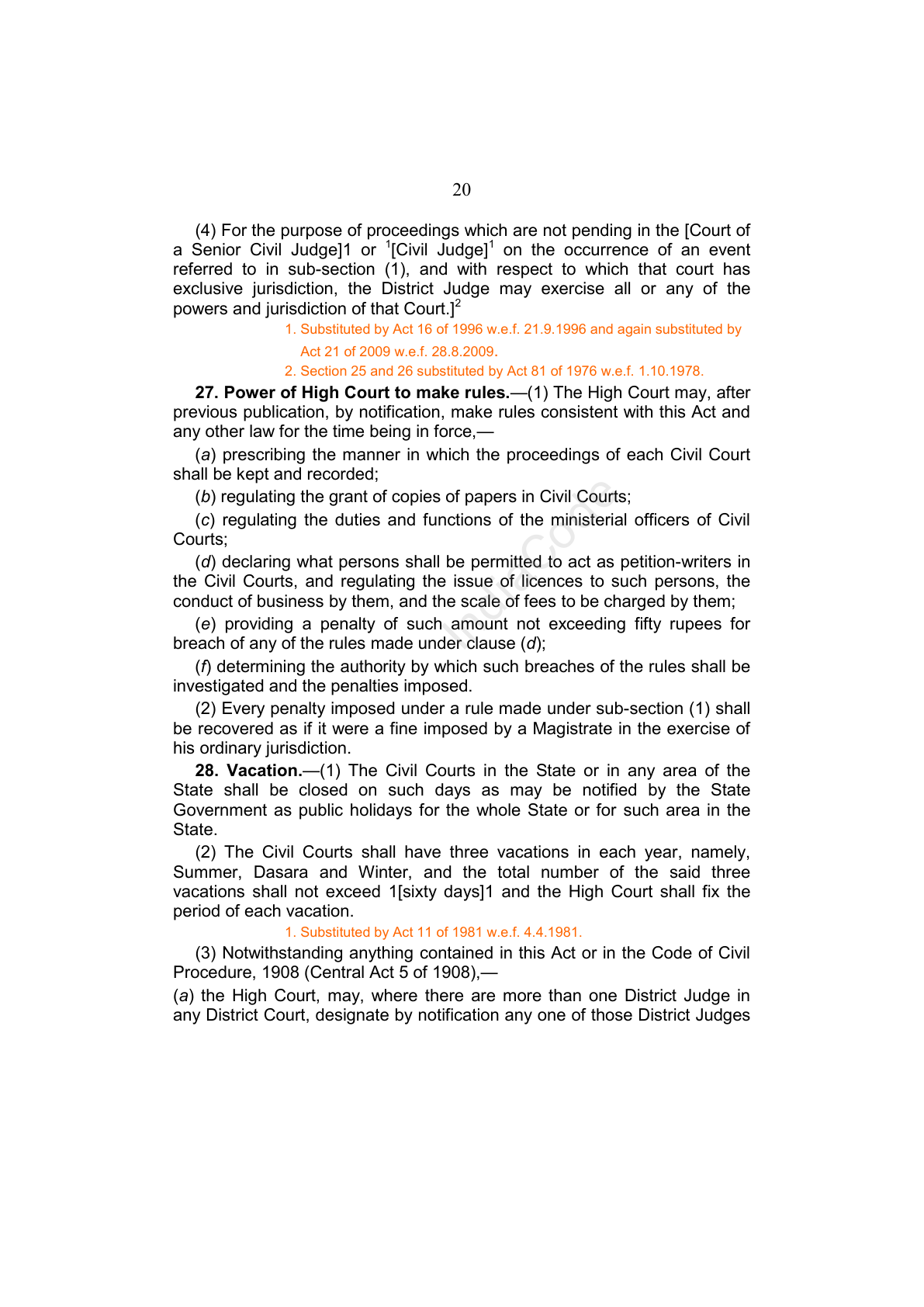
Unreviewed complete page layout text
                                          20

   (4) For the purpose of proceedings which are not pending in the [Court of
a Senior Civil Judge]1 or 1[Civil Judge]1 on the occurrence of an event
referred to in sub-section (1), and with respect to which that court has
exclusive jurisdiction, the District Judge may exercise all or any of the
powers and jurisdiction of that Court.]2
               1. Substituted by Act 16 of 1996 w.e.f. 21.9.1996 and again substituted by
                  Act 21 of 2009 w.e.f. 28.8.2009.
               2. Section 25 and 26 substituted by Act 81 of 1976 w.e.f. 1.10.1978.
   27. Power of High Court to make rules.—(1) The High Court may, after
previous publication, by notification, make rules consistent with this Act and
any other law for the time being in force,—
   (a) prescribing the manner in which the proceedings of each Civil Court
shall be kept and recorded;
   (b) regulating the grant of copies of papers in Civil Courts;
                                                             e
                                                       od
   (c) regulating the duties and functions of the ministerial officers of Civil
Courts;
                                                aC
   (d) declaring what persons shall be permitted to act as petition-writers in
the Civil Courts, and regulating the issue of licences to such persons, the
conduct of business by them, and the scale of fees to be charged by them;
                                           di
   (e) providing a penalty of such amount not exceeding fifty rupees for
                                      In
breach of any of the rules made under clause (d);
   (f) determining the authority by which such breaches of the rules shall be
investigated and the penalties imposed.
   (2) Every penalty imposed under a rule made under sub-section (1) shall
be recovered as if it were a fine imposed by a Magistrate in the exercise of
his ordinary jurisdiction.
   28. Vacation.—(1) The Civil Courts in the State or in any area of the
State shall be closed on such days as may be notified by the State
Government as public holidays for the whole State or for such area in the
State.
   (2) The Civil Courts shall have three vacations in each year, namely,
Summer, Dasara and Winter, and the total number of the said three
vacations shall not exceed 1[sixty days]1 and the High Court shall fix the
period of each vacation.
               1. Substituted by Act 11 of 1981 w.e.f. 4.4.1981.
   (3) Notwithstanding anything contained in this Act or in the Code of Civil
Procedure, 1908 (Central Act 5 of 1908),—
(a) the High Court, may, where there are more than one District Judge in
any District Court, designate by notification any one of those District Judges