Delhi Shops and Establishments Act,1954 — Physical PDF page 6 of 27
Unreviewed source-only snapshot. Full pages may contain principal wording, editorial commentary, tables, footnotes and appended documentary material. This is not approved current law or a purified section corpus.
Catalogue jurisdiction: Delhi; territorial applicability is unverified.
- 27 literal COMMENTS labels and embedded case commentary/quotations are source content, not isolated statute.
- Section 4 references an appended Schedule, but no standalone Schedule body heading appears before delivered section-48 tail. Do not infer the referenced Schedule is supplied.
- TOC watermark overlaps split some heading captions; do not create citation boundaries from candidate scan.
- Delivered/catalogue checksum and size discrepancies remain unresolved; no currentness, legal-text fidelity or human approval.
Download complete pinned PDF · All physical pages
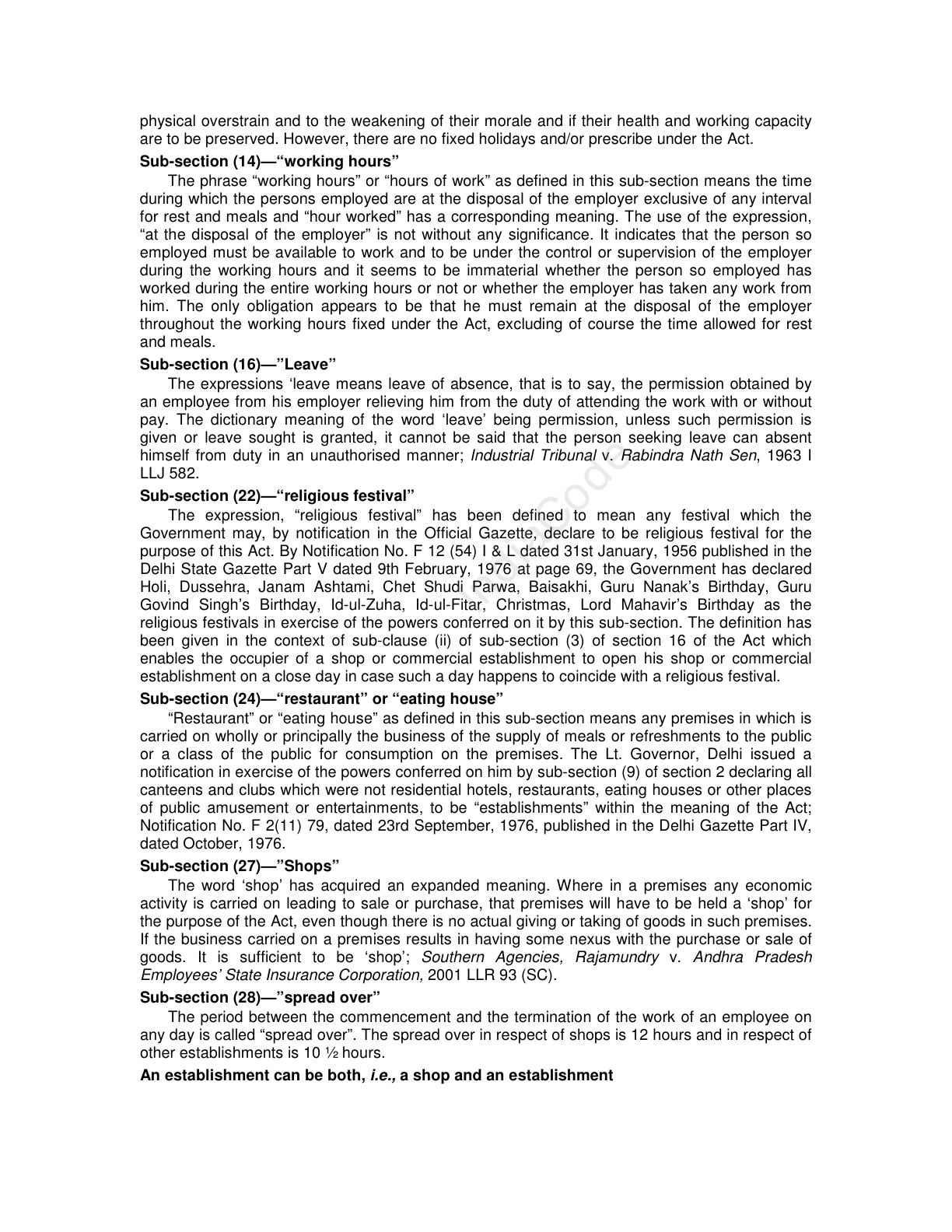
Unreviewed complete page layout text
physical overstrain and to the weakening of their morale and if their health and working capacity
are to be preserved. However, there are no fixed holidays and/or prescribe under the Act.
Sub-section (14)—“working hours”
     The phrase “working hours” or “hours of work” as defined in this sub-section means the time
during which the persons employed are at the disposal of the employer exclusive of any interval
for rest and meals and “hour worked” has a corresponding meaning. The use of the expression,
“at the disposal of the employer” is not without any significance. It indicates that the person so
employed must be available to work and to be under the control or supervision of the employer
during the working hours and it seems to be immaterial whether the person so employed has
worked during the entire working hours or not or whether the employer has taken any work from
him. The only obligation appears to be that he must remain at the disposal of the employer
throughout the working hours fixed under the Act, excluding of course the time allowed for rest
and meals.
Sub-section (16)—”Leave”
     The expressions ‘leave means leave of absence, that is to say, the permission obtained by
an employee from his employer relieving him from the duty of attending the work with or without
pay. The dictionary meaning of the word ‘leave’ being permission, unless such permission is
given or leave sought is granted, it cannot be said that the person seeking leave can absent
himself from duty in an unauthorised manner; Industrial Tribunal v. Rabindra Nath Sen, 1963 I
LLJ 582.
                                                                  e
Sub-section (22)—“religious festival”                       od
     The expression, “religious festival” has been defined to mean any festival which the
                                                      aC
Government may, by notification in the Official Gazette, declare to be religious festival for the
purpose of this Act. By Notification No. F 12 (54) I & L dated 31st January, 1956 published in the
                                                 di
Delhi State Gazette Part V dated 9th February, 1976 at page 69, the Government has declared
Holi, Dussehra, Janam Ashtami, Chet Shudi Parwa, Baisakhi, Guru Nanak’s Birthday, Guru
                                             In
Govind Singh’s Birthday, Id-ul-Zuha, Id-ul-Fitar, Christmas, Lord Mahavir’s Birthday as the
religious festivals in exercise of the powers conferred on it by this sub-section. The definition has
been given in the context of sub-clause (ii) of sub-section (3) of section 16 of the Act which
enables the occupier of a shop or commercial establishment to open his shop or commercial
establishment on a close day in case such a day happens to coincide with a religious festival.
Sub-section (24)—“restaurant” or “eating house”
     “Restaurant” or “eating house” as defined in this sub-section means any premises in which is
carried on wholly or principally the business of the supply of meals or refreshments to the public
or a class of the public for consumption on the premises. The Lt. Governor, Delhi issued a
notification in exercise of the powers conferred on him by sub-section (9) of section 2 declaring all
canteens and clubs which were not residential hotels, restaurants, eating houses or other places
of public amusement or entertainments, to be “establishments” within the meaning of the Act;
Notification No. F 2(11) 79, dated 23rd September, 1976, published in the Delhi Gazette Part IV,
dated October, 1976.
Sub-section (27)—”Shops”
     The word ‘shop’ has acquired an expanded meaning. Where in a premises any economic
activity is carried on leading to sale or purchase, that premises will have to be held a ‘shop’ for
the purpose of the Act, even though there is no actual giving or taking of goods in such premises.
If the business carried on a premises results in having some nexus with the purchase or sale of
goods. It is sufficient to be ‘shop’; Southern Agencies, Rajamundry v. Andhra Pradesh
Employees’ State Insurance Corporation, 2001 LLR 93 (SC).
Sub-section (28)—”spread over”
     The period between the commencement and the termination of the work of an employee on
any day is called “spread over”. The spread over in respect of shops is 12 hours and in respect of
other establishments is 10 ½ hours.
An establishment can be both, i.e., a shop and an establishment