Delhi Shops and Establishments Act,1954 — Physical PDF page 24 of 27
Unreviewed source-only snapshot. Full pages may contain principal wording, editorial commentary, tables, footnotes and appended documentary material. This is not approved current law or a purified section corpus.
Catalogue jurisdiction: Delhi; territorial applicability is unverified.
- 27 literal COMMENTS labels and embedded case commentary/quotations are source content, not isolated statute.
- Section 4 references an appended Schedule, but no standalone Schedule body heading appears before delivered section-48 tail. Do not infer the referenced Schedule is supplied.
- TOC watermark overlaps split some heading captions; do not create citation boundaries from candidate scan.
- Delivered/catalogue checksum and size discrepancies remain unresolved; no currentness, legal-text fidelity or human approval.
Download complete pinned PDF · All physical pages
Unreviewed complete page layout text
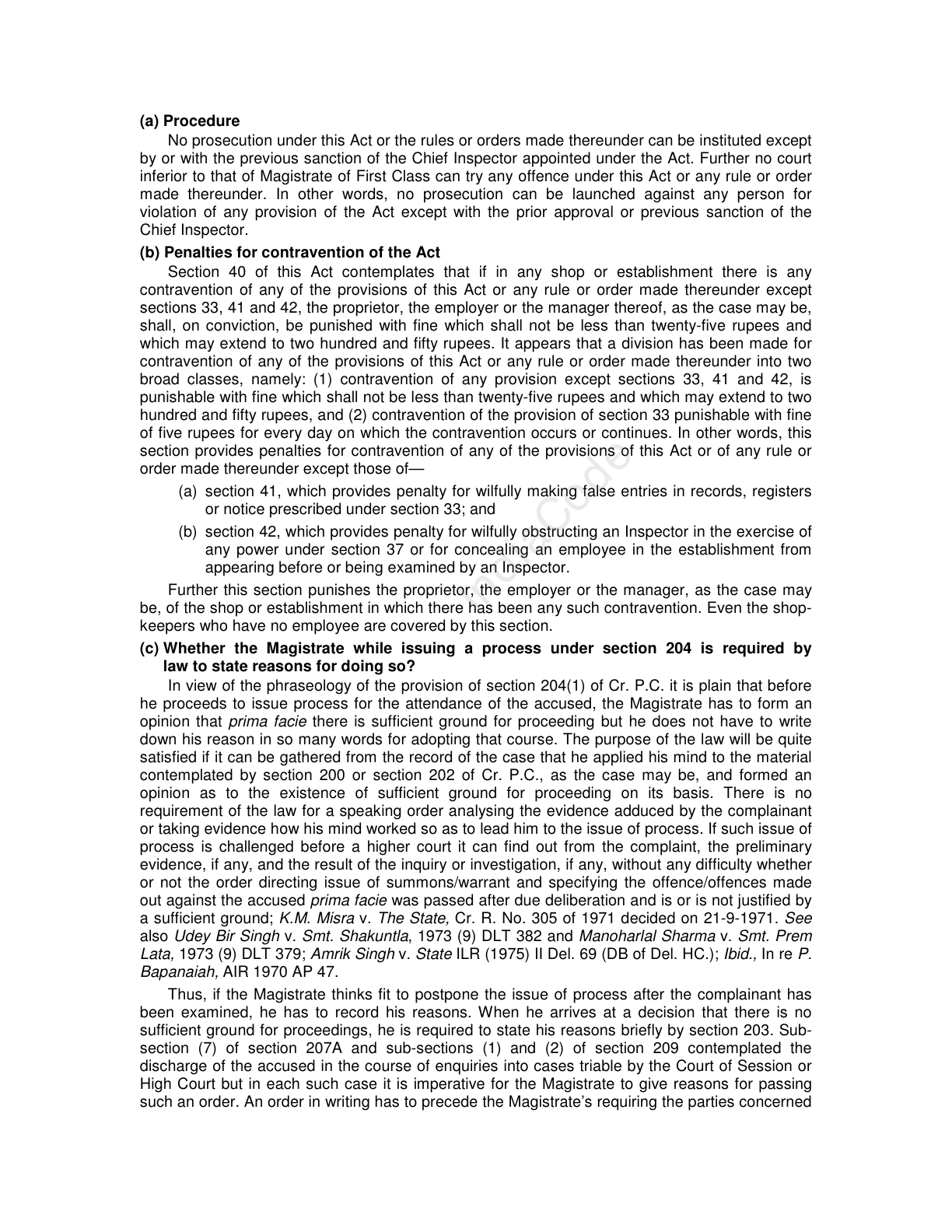
(a) Procedure
     No prosecution under this Act or the rules or orders made thereunder can be instituted except
by or with the previous sanction of the Chief Inspector appointed under the Act. Further no court
inferior to that of Magistrate of First Class can try any offence under this Act or any rule or order
made thereunder. In other words, no prosecution can be launched against any person for
violation of any provision of the Act except with the prior approval or previous sanction of the
Chief Inspector.
(b) Penalties for contravention of the Act
     Section 40 of this Act contemplates that if in any shop or establishment there is any
contravention of any of the provisions of this Act or any rule or order made thereunder except
sections 33, 41 and 42, the proprietor, the employer or the manager thereof, as the case may be,
shall, on conviction, be punished with fine which shall not be less than twenty-five rupees and
which may extend to two hundred and fifty rupees. It appears that a division has been made for
contravention of any of the provisions of this Act or any rule or order made thereunder into two
broad classes, namely: (1) contravention of any provision except sections 33, 41 and 42, is
punishable with fine which shall not be less than twenty-five rupees and which may extend to two
hundred and fifty rupees, and (2) contravention of the provision of section 33 punishable with fine
of five rupees for every day on which the contravention occurs or continues. In other words, this
section provides penalties for contravention of any of the provisions of this Act or of any rule or
order made thereunder except those of—                              e
                                                              od
       (a) section 41, which provides penalty for wilfully making false entries in records, registers
           or notice prescribed under section 33; and
                                                       aC
       (b) section 42, which provides penalty for wilfully obstructing an Inspector in the exercise of
           any power under section 37 or for concealing an employee in the establishment from
                                                   di
           appearing before or being examined by an Inspector.
     Further this section punishes the proprietor, the employer or the manager, as the case may
                                              In
be, of the shop or establishment in which there has been any such contravention. Even the shop-
keepers who have no employee are covered by this section.
(c) Whether the Magistrate while issuing a process under section 204 is required by
    law to state reasons for doing so?
     In view of the phraseology of the provision of section 204(1) of Cr. P.C. it is plain that before
he proceeds to issue process for the attendance of the accused, the Magistrate has to form an
opinion that prima facie there is sufficient ground for proceeding but he does not have to write
down his reason in so many words for adopting that course. The purpose of the law will be quite
satisfied if it can be gathered from the record of the case that he applied his mind to the material
contemplated by section 200 or section 202 of Cr. P.C., as the case may be, and formed an
opinion as to the existence of sufficient ground for proceeding on its basis. There is no
requirement of the law for a speaking order analysing the evidence adduced by the complainant
or taking evidence how his mind worked so as to lead him to the issue of process. If such issue of
process is challenged before a higher court it can find out from the complaint, the preliminary
evidence, if any, and the result of the inquiry or investigation, if any, without any difficulty whether
or not the order directing issue of summons/warrant and specifying the offence/offences made
out against the accused prima facie was passed after due deliberation and is or is not justified by
a sufficient ground; K.M. Misra v. The State, Cr. R. No. 305 of 1971 decided on 21-9-1971. See
also Udey Bir Singh v. Smt. Shakuntla, 1973 (9) DLT 382 and Manoharlal Sharma v. Smt. Prem
Lata, 1973 (9) DLT 379; Amrik Singh v. State ILR (1975) II Del. 69 (DB of Del. HC.); Ibid., In re P.
Bapanaiah, AIR 1970 AP 47.
     Thus, if the Magistrate thinks fit to postpone the issue of process after the complainant has
been examined, he has to record his reasons. When he arrives at a decision that there is no
sufficient ground for proceedings, he is required to state his reasons briefly by section 203. Sub-
section (7) of section 207A and sub-sections (1) and (2) of section 209 contemplated the
discharge of the accused in the course of enquiries into cases triable by the Court of Session or
High Court but in each such case it is imperative for the Magistrate to give reasons for passing
such an order. An order in writing has to precede the Magistrate’s requiring the parties concerned