Delhi Shops and Establishments Act,1954 — Physical PDF page 21 of 27
Unreviewed source-only snapshot. Full pages may contain principal wording, editorial commentary, tables, footnotes and appended documentary material. This is not approved current law or a purified section corpus.
Catalogue jurisdiction: Delhi; territorial applicability is unverified.
- 27 literal COMMENTS labels and embedded case commentary/quotations are source content, not isolated statute.
- Section 4 references an appended Schedule, but no standalone Schedule body heading appears before delivered section-48 tail. Do not infer the referenced Schedule is supplied.
- TOC watermark overlaps split some heading captions; do not create citation boundaries from candidate scan.
- Delivered/catalogue checksum and size discrepancies remain unresolved; no currentness, legal-text fidelity or human approval.
Download complete pinned PDF · All physical pages
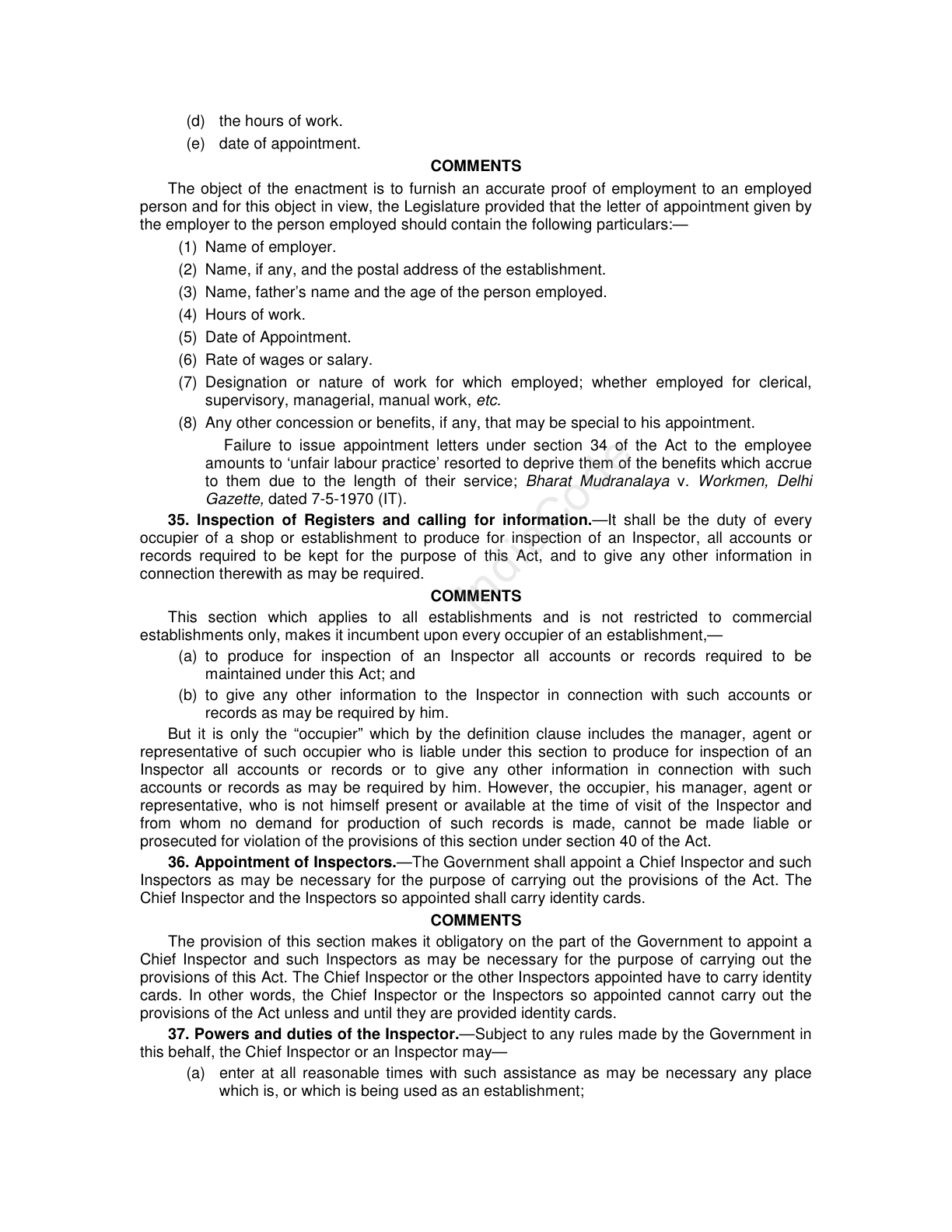
Unreviewed complete page layout text
      (d) the hours of work.
      (e) date of appointment.
                                            COMMENTS
     The object of the enactment is to furnish an accurate proof of employment to an employed
person and for this object in view, the Legislature provided that the letter of appointment given by
the employer to the person employed should contain the following particulars:—
      (1) Name of employer.
      (2) Name, if any, and the postal address of the establishment.
      (3) Name, father’s name and the age of the person employed.
      (4) Hours of work.
      (5) Date of Appointment.
      (6) Rate of wages or salary.
      (7) Designation or nature of work for which employed; whether employed for clerical,
           supervisory, managerial, manual work, etc.
      (8) Any other concession or benefits, if any, that may be special to his appointment.
              Failure to issue appointment letters under section 34 of the Act to the employee
                                                                 e
           amounts to ‘unfair labour practice’ resorted to deprive them of the benefits which accrue
           to them due to the length of their service; Bharat Mudranalaya v. Workmen, Delhi
           Gazette, dated 7-5-1970 (IT).
                                                           od
     35. Inspection of Registers and calling for information.—It shall be the duty of every
                                                     aC
occupier of a shop or establishment to produce for inspection of an Inspector, all accounts or
records required to be kept for the purpose of this Act, and to give any other information in
connection therewith as may be required.         di
                                            In
                                            COMMENTS
     This section which applies to all establishments and is not restricted to commercial
establishments only, makes it incumbent upon every occupier of an establishment,—
      (a) to produce for inspection of an Inspector all accounts or records required to be
           maintained under this Act; and
      (b) to give any other information to the Inspector in connection with such accounts or
           records as may be required by him.
     But it is only the “occupier” which by the definition clause includes the manager, agent or
representative of such occupier who is liable under this section to produce for inspection of an
Inspector all accounts or records or to give any other information in connection with such
accounts or records as may be required by him. However, the occupier, his manager, agent or
representative, who is not himself present or available at the time of visit of the Inspector and
from whom no demand for production of such records is made, cannot be made liable or
prosecuted for violation of the provisions of this section under section 40 of the Act.
     36. Appointment of Inspectors.—The Government shall appoint a Chief Inspector and such
Inspectors as may be necessary for the purpose of carrying out the provisions of the Act. The
Chief Inspector and the Inspectors so appointed shall carry identity cards.
                                            COMMENTS
     The provision of this section makes it obligatory on the part of the Government to appoint a
Chief Inspector and such Inspectors as may be necessary for the purpose of carrying out the
provisions of this Act. The Chief Inspector or the other Inspectors appointed have to carry identity
cards. In other words, the Chief Inspector or the Inspectors so appointed cannot carry out the
provisions of the Act unless and until they are provided identity cards.
     37. Powers and duties of the Inspector.—Subject to any rules made by the Government in
this behalf, the Chief Inspector or an Inspector may—
       (a) enter at all reasonable times with such assistance as may be necessary any place
             which is, or which is being used as an establishment;