Delhi Shops and Establishments Act,1954 — Physical PDF page 15 of 27
Unreviewed source-only snapshot. Full pages may contain principal wording, editorial commentary, tables, footnotes and appended documentary material. This is not approved current law or a purified section corpus.
Catalogue jurisdiction: Delhi; territorial applicability is unverified.
- 27 literal COMMENTS labels and embedded case commentary/quotations are source content, not isolated statute.
- Section 4 references an appended Schedule, but no standalone Schedule body heading appears before delivered section-48 tail. Do not infer the referenced Schedule is supplied.
- TOC watermark overlaps split some heading captions; do not create citation boundaries from candidate scan.
- Delivered/catalogue checksum and size discrepancies remain unresolved; no currentness, legal-text fidelity or human approval.
Download complete pinned PDF · All physical pages
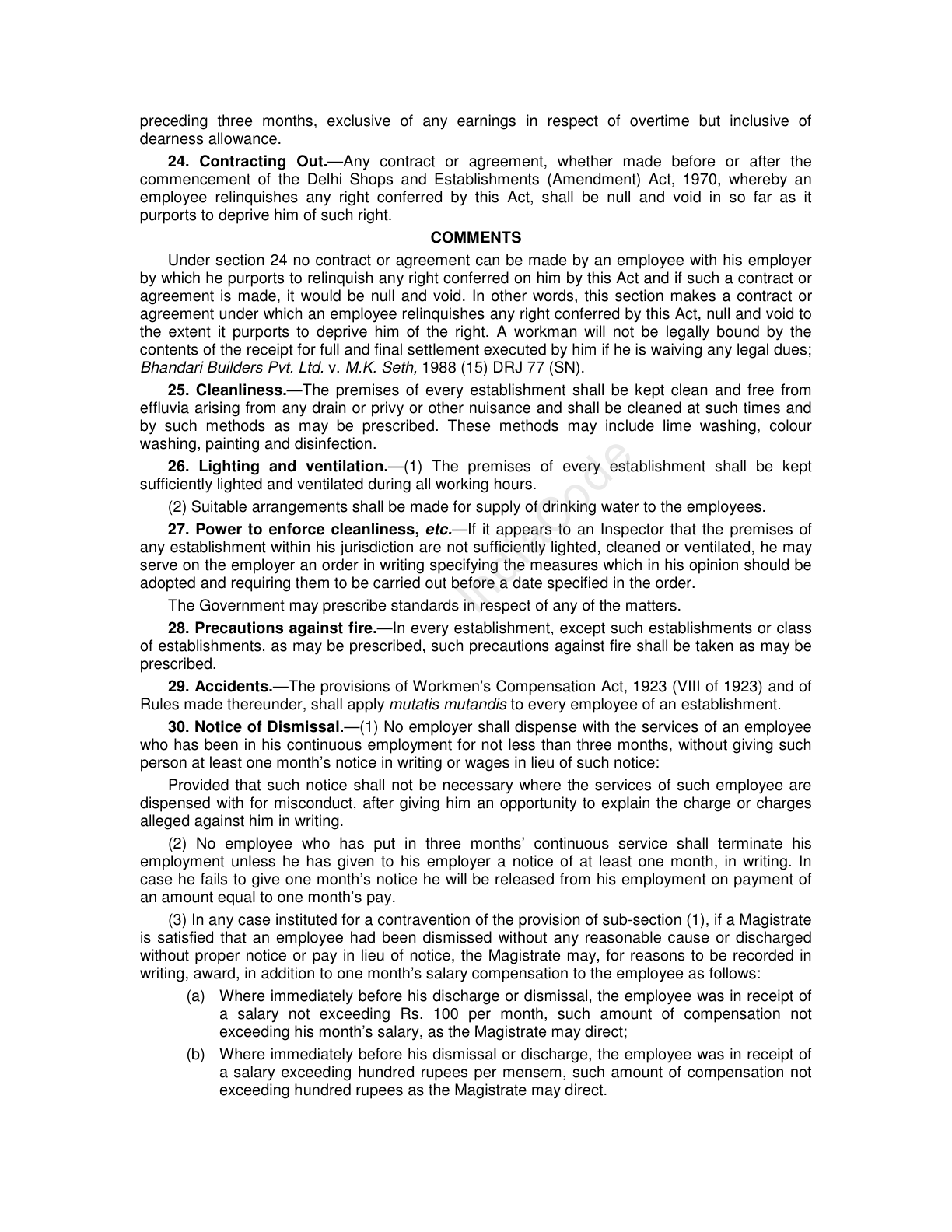
Unreviewed complete page layout text
preceding three months, exclusive of any earnings in respect of overtime but inclusive of
dearness allowance.
     24. Contracting Out.—Any contract or agreement, whether made before or after the
commencement of the Delhi Shops and Establishments (Amendment) Act, 1970, whereby an
employee relinquishes any right conferred by this Act, shall be null and void in so far as it
purports to deprive him of such right.
                                               COMMENTS
     Under section 24 no contract or agreement can be made by an employee with his employer
by which he purports to relinquish any right conferred on him by this Act and if such a contract or
agreement is made, it would be null and void. In other words, this section makes a contract or
agreement under which an employee relinquishes any right conferred by this Act, null and void to
the extent it purports to deprive him of the right. A workman will not be legally bound by the
contents of the receipt for full and final settlement executed by him if he is waiving any legal dues;
Bhandari Builders Pvt. Ltd. v. M.K. Seth, 1988 (15) DRJ 77 (SN).
     25. Cleanliness.—The premises of every establishment shall be kept clean and free from
effluvia arising from any drain or privy or other nuisance and shall be cleaned at such times and
by such methods as may be prescribed. These methods may include lime washing, colour
washing, painting and disinfection.
                                                                    e
     26. Lighting and ventilation.—(1) The premises of every establishment shall be kept
sufficiently lighted and ventilated during all working hours. od
     (2) Suitable arrangements shall be made for supply of drinking water to the employees.
                                                       aC
     27. Power to enforce cleanliness, etc.—If it appears to an Inspector that the premises of
any establishment within his jurisdiction are not sufficiently lighted, cleaned or ventilated, he may
                                                   di
serve on the employer an order in writing specifying the measures which in his opinion should be
adopted and requiring them to be carried out before a date specified in the order.
                                              In
     The Government may prescribe standards in respect of any of the matters.
     28. Precautions against fire.—In every establishment, except such establishments or class
of establishments, as may be prescribed, such precautions against fire shall be taken as may be
prescribed.
     29. Accidents.—The provisions of Workmen’s Compensation Act, 1923 (VIII of 1923) and of
Rules made thereunder, shall apply mutatis mutandis to every employee of an establishment.
     30. Notice of Dismissal.—(1) No employer shall dispense with the services of an employee
who has been in his continuous employment for not less than three months, without giving such
person at least one month’s notice in writing or wages in lieu of such notice:
     Provided that such notice shall not be necessary where the services of such employee are
dispensed with for misconduct, after giving him an opportunity to explain the charge or charges
alleged against him in writing.
     (2) No employee who has put in three months’ continuous service shall terminate his
employment unless he has given to his employer a notice of at least one month, in writing. In
case he fails to give one month’s notice he will be released from his employment on payment of
an amount equal to one month’s pay.
     (3) In any case instituted for a contravention of the provision of sub-section (1), if a Magistrate
is satisfied that an employee had been dismissed without any reasonable cause or discharged
without proper notice or pay in lieu of notice, the Magistrate may, for reasons to be recorded in
writing, award, in addition to one month’s salary compensation to the employee as follows:
        (a) Where immediately before his discharge or dismissal, the employee was in receipt of
              a salary not exceeding Rs. 100 per month, such amount of compensation not
              exceeding his month’s salary, as the Magistrate may direct;
        (b) Where immediately before his dismissal or discharge, the employee was in receipt of
              a salary exceeding hundred rupees per mensem, such amount of compensation not
              exceeding hundred rupees as the Magistrate may direct.