Delhi Shops and Establishments Act,1954 — Physical PDF page 14 of 27
Unreviewed source-only snapshot. Full pages may contain principal wording, editorial commentary, tables, footnotes and appended documentary material. This is not approved current law or a purified section corpus.
Catalogue jurisdiction: Delhi; territorial applicability is unverified.
- 27 literal COMMENTS labels and embedded case commentary/quotations are source content, not isolated statute.
- Section 4 references an appended Schedule, but no standalone Schedule body heading appears before delivered section-48 tail. Do not infer the referenced Schedule is supplied.
- TOC watermark overlaps split some heading captions; do not create citation boundaries from candidate scan.
- Delivered/catalogue checksum and size discrepancies remain unresolved; no currentness, legal-text fidelity or human approval.
Download complete pinned PDF · All physical pages
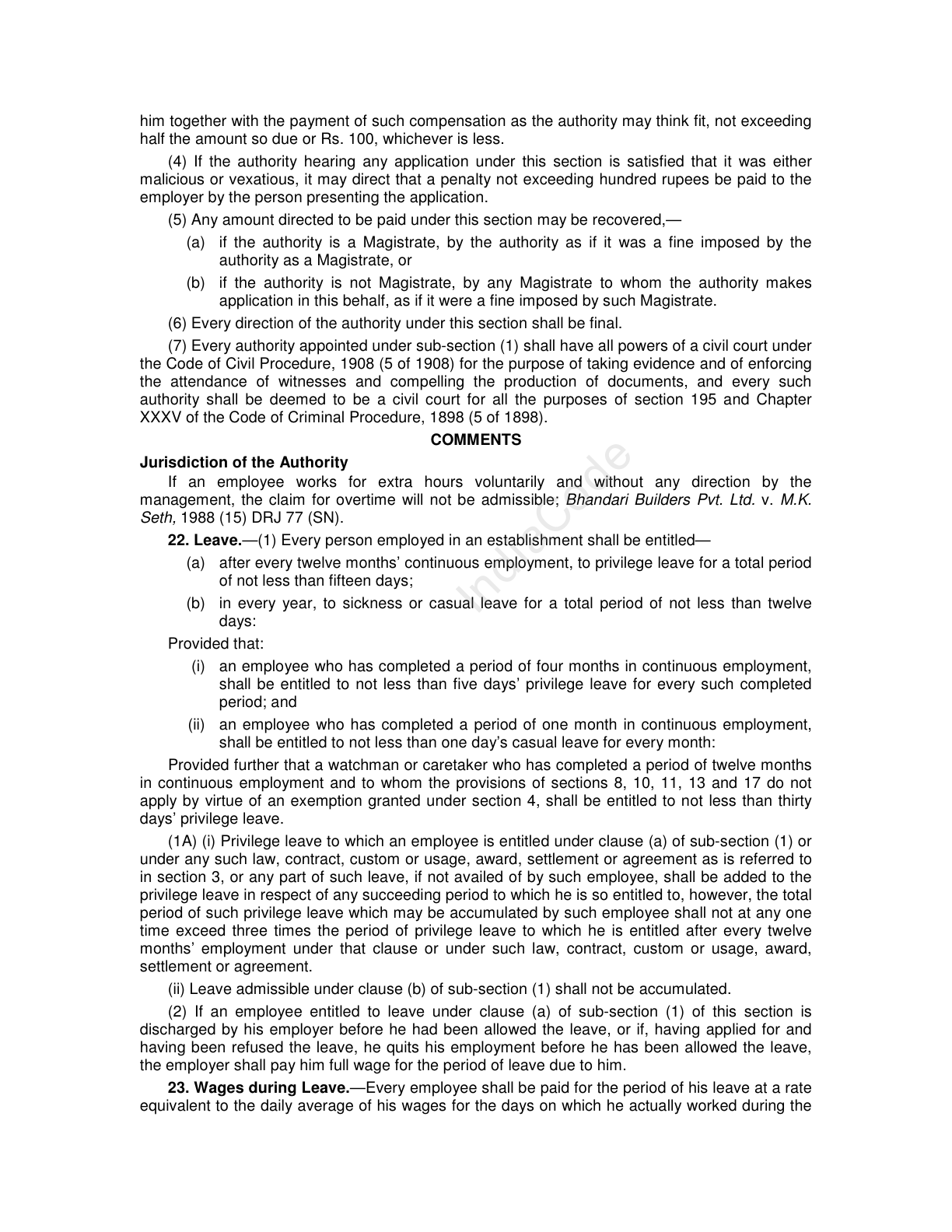
Unreviewed complete page layout text
him together with the payment of such compensation as the authority may think fit, not exceeding
half the amount so due or Rs. 100, whichever is less.
     (4) If the authority hearing any application under this section is satisfied that it was either
malicious or vexatious, it may direct that a penalty not exceeding hundred rupees be paid to the
employer by the person presenting the application.
     (5) Any amount directed to be paid under this section may be recovered,—
         (a) if the authority is a Magistrate, by the authority as if it was a fine imposed by the
               authority as a Magistrate, or
         (b) if the authority is not Magistrate, by any Magistrate to whom the authority makes
               application in this behalf, as if it were a fine imposed by such Magistrate.
     (6) Every direction of the authority under this section shall be final.
     (7) Every authority appointed under sub-section (1) shall have all powers of a civil court under
the Code of Civil Procedure, 1908 (5 of 1908) for the purpose of taking evidence and of enforcing
the attendance of witnesses and compelling the production of documents, and every such
authority shall be deemed to be a civil court for all the purposes of section 195 and Chapter
XXXV of the Code of Criminal Procedure, 1898 (5 of 1898).
                                                  COMMENTS
Jurisdiction of the Authority                                     e
                                                            od
     If an employee works for extra hours voluntarily and without any direction by the
management, the claim for overtime will not be admissible; Bhandari Builders Pvt. Ltd. v. M.K.
Seth, 1988 (15) DRJ 77 (SN).
                                                      aC
     22. Leave.—(1) Every person employed in an establishment shall be entitled—
         (a) after every twelve months’ continuous employment, to privilege leave for a total period
                                                 di
               of not less than fifteen days;
                                             In
         (b) in every year, to sickness or casual leave for a total period of not less than twelve
               days:
     Provided that:
           (i) an employee who has completed a period of four months in continuous employment,
               shall be entitled to not less than five days’ privilege leave for every such completed
               period; and
          (ii) an employee who has completed a period of one month in continuous employment,
               shall be entitled to not less than one day’s casual leave for every month:
     Provided further that a watchman or caretaker who has completed a period of twelve months
in continuous employment and to whom the provisions of sections 8, 10, 11, 13 and 17 do not
apply by virtue of an exemption granted under section 4, shall be entitled to not less than thirty
days’ privilege leave.
     (1A) (i) Privilege leave to which an employee is entitled under clause (a) of sub-section (1) or
under any such law, contract, custom or usage, award, settlement or agreement as is referred to
in section 3, or any part of such leave, if not availed of by such employee, shall be added to the
privilege leave in respect of any succeeding period to which he is so entitled to, however, the total
period of such privilege leave which may be accumulated by such employee shall not at any one
time exceed three times the period of privilege leave to which he is entitled after every twelve
months’ employment under that clause or under such law, contract, custom or usage, award,
settlement or agreement.
     (ii) Leave admissible under clause (b) of sub-section (1) shall not be accumulated.
     (2) If an employee entitled to leave under clause (a) of sub-section (1) of this section is
discharged by his employer before he had been allowed the leave, or if, having applied for and
having been refused the leave, he quits his employment before he has been allowed the leave,
the employer shall pay him full wage for the period of leave due to him.
     23. Wages during Leave.—Every employee shall be paid for the period of his leave at a rate
equivalent to the daily average of his wages for the days on which he actually worked during the