Delhi Shops and Establishments Act,1954 — Physical PDF page 13 of 27
Unreviewed source-only snapshot. Full pages may contain principal wording, editorial commentary, tables, footnotes and appended documentary material. This is not approved current law or a purified section corpus.
Catalogue jurisdiction: Delhi; territorial applicability is unverified.
- 27 literal COMMENTS labels and embedded case commentary/quotations are source content, not isolated statute.
- Section 4 references an appended Schedule, but no standalone Schedule body heading appears before delivered section-48 tail. Do not infer the referenced Schedule is supplied.
- TOC watermark overlaps split some heading captions; do not create citation boundaries from candidate scan.
- Delivered/catalogue checksum and size discrepancies remain unresolved; no currentness, legal-text fidelity or human approval.
Download complete pinned PDF · All physical pages
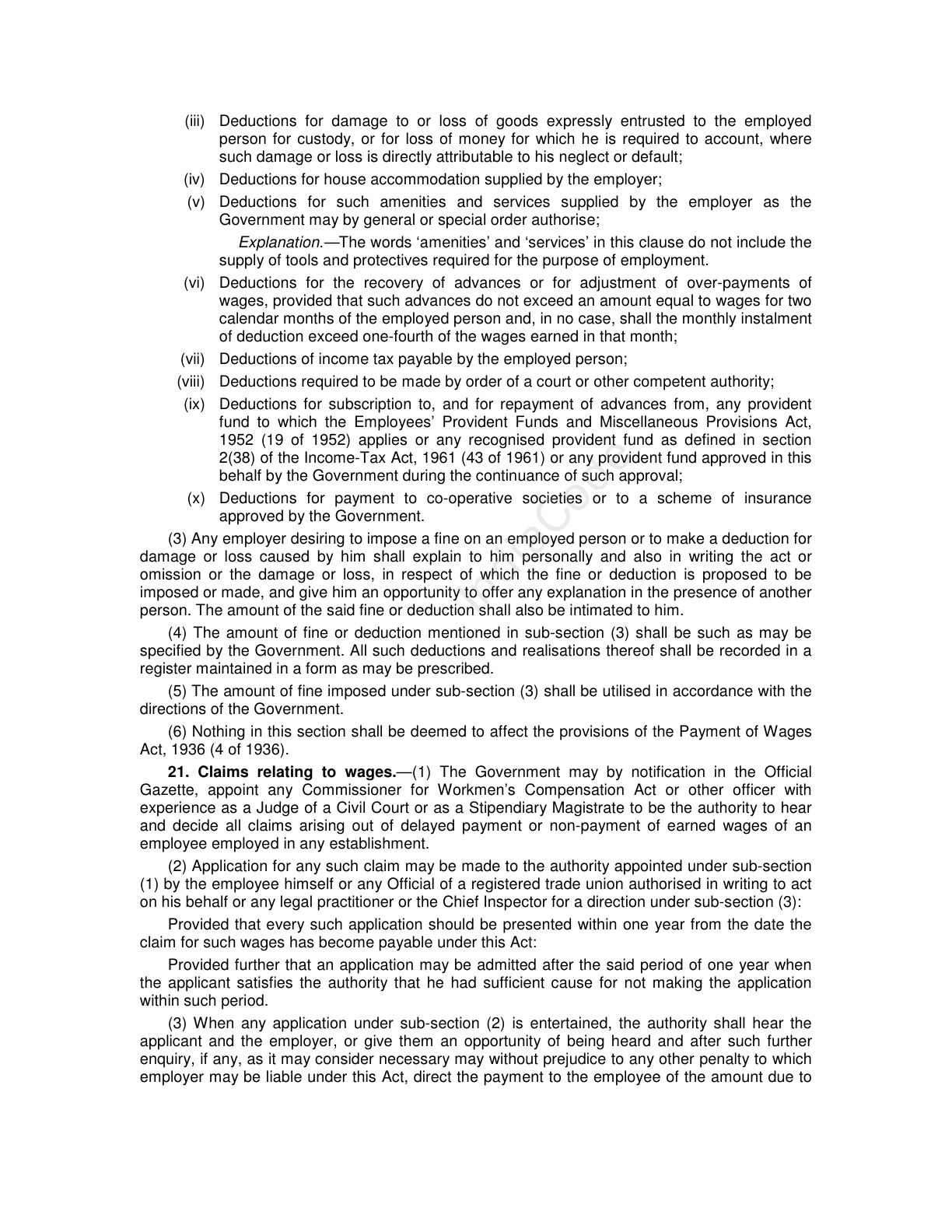
Unreviewed complete page layout text
        (iii) Deductions for damage to or loss of goods expressly entrusted to the employed
              person for custody, or for loss of money for which he is required to account, where
              such damage or loss is directly attributable to his neglect or default;
        (iv) Deductions for house accommodation supplied by the employer;
         (v) Deductions for such amenities and services supplied by the employer as the
              Government may by general or special order authorise;
                 Explanation.—The words ‘amenities’ and ‘services’ in this clause do not include the
              supply of tools and protectives required for the purpose of employment.
        (vi) Deductions for the recovery of advances or for adjustment of over-payments of
              wages, provided that such advances do not exceed an amount equal to wages for two
              calendar months of the employed person and, in no case, shall the monthly instalment
              of deduction exceed one-fourth of the wages earned in that month;
       (vii) Deductions of income tax payable by the employed person;
      (viii) Deductions required to be made by order of a court or other competent authority;
        (ix) Deductions for subscription to, and for repayment of advances from, any provident
              fund to which the Employees’ Provident Funds and Miscellaneous Provisions Act,
              1952 (19 of 1952) applies or any recognised provident fund as defined in section
              2(38) of the Income-Tax Act, 1961 (43 of 1961) or any provident fund approved in this
                                                                  e
              behalf by the Government during the continuance of such approval;
                                                            od
         (x) Deductions for payment to co-operative societies or to a scheme of insurance
              approved by the Government.
                                                      aC
    (3) Any employer desiring to impose a fine on an employed person or to make a deduction for
damage or loss caused by him shall explain to him personally and also in writing the act or
                                                 di
omission or the damage or loss, in respect of which the fine or deduction is proposed to be
imposed or made, and give him an opportunity to offer any explanation in the presence of another
                                             In
person. The amount of the said fine or deduction shall also be intimated to him.
    (4) The amount of fine or deduction mentioned in sub-section (3) shall be such as may be
specified by the Government. All such deductions and realisations thereof shall be recorded in a
register maintained in a form as may be prescribed.
    (5) The amount of fine imposed under sub-section (3) shall be utilised in accordance with the
directions of the Government.
    (6) Nothing in this section shall be deemed to affect the provisions of the Payment of Wages
Act, 1936 (4 of 1936).
    21. Claims relating to wages.—(1) The Government may by notification in the Official
Gazette, appoint any Commissioner for Workmen’s Compensation Act or other officer with
experience as a Judge of a Civil Court or as a Stipendiary Magistrate to be the authority to hear
and decide all claims arising out of delayed payment or non-payment of earned wages of an
employee employed in any establishment.
    (2) Application for any such claim may be made to the authority appointed under sub-section
(1) by the employee himself or any Official of a registered trade union authorised in writing to act
on his behalf or any legal practitioner or the Chief Inspector for a direction under sub-section (3):
    Provided that every such application should be presented within one year from the date the
claim for such wages has become payable under this Act:
    Provided further that an application may be admitted after the said period of one year when
the applicant satisfies the authority that he had sufficient cause for not making the application
within such period.
    (3) When any application under sub-section (2) is entertained, the authority shall hear the
applicant and the employer, or give them an opportunity of being heard and after such further
enquiry, if any, as it may consider necessary may without prejudice to any other penalty to which
employer may be liable under this Act, direct the payment to the employee of the amount due to