Delhi Shops and Establishments Act,1954 — Physical PDF page 10 of 27
Unreviewed source-only snapshot. Full pages may contain principal wording, editorial commentary, tables, footnotes and appended documentary material. This is not approved current law or a purified section corpus.
Catalogue jurisdiction: Delhi; territorial applicability is unverified.
- 27 literal COMMENTS labels and embedded case commentary/quotations are source content, not isolated statute.
- Section 4 references an appended Schedule, but no standalone Schedule body heading appears before delivered section-48 tail. Do not infer the referenced Schedule is supplied.
- TOC watermark overlaps split some heading captions; do not create citation boundaries from candidate scan.
- Delivered/catalogue checksum and size discrepancies remain unresolved; no currentness, legal-text fidelity or human approval.
Download complete pinned PDF · All physical pages
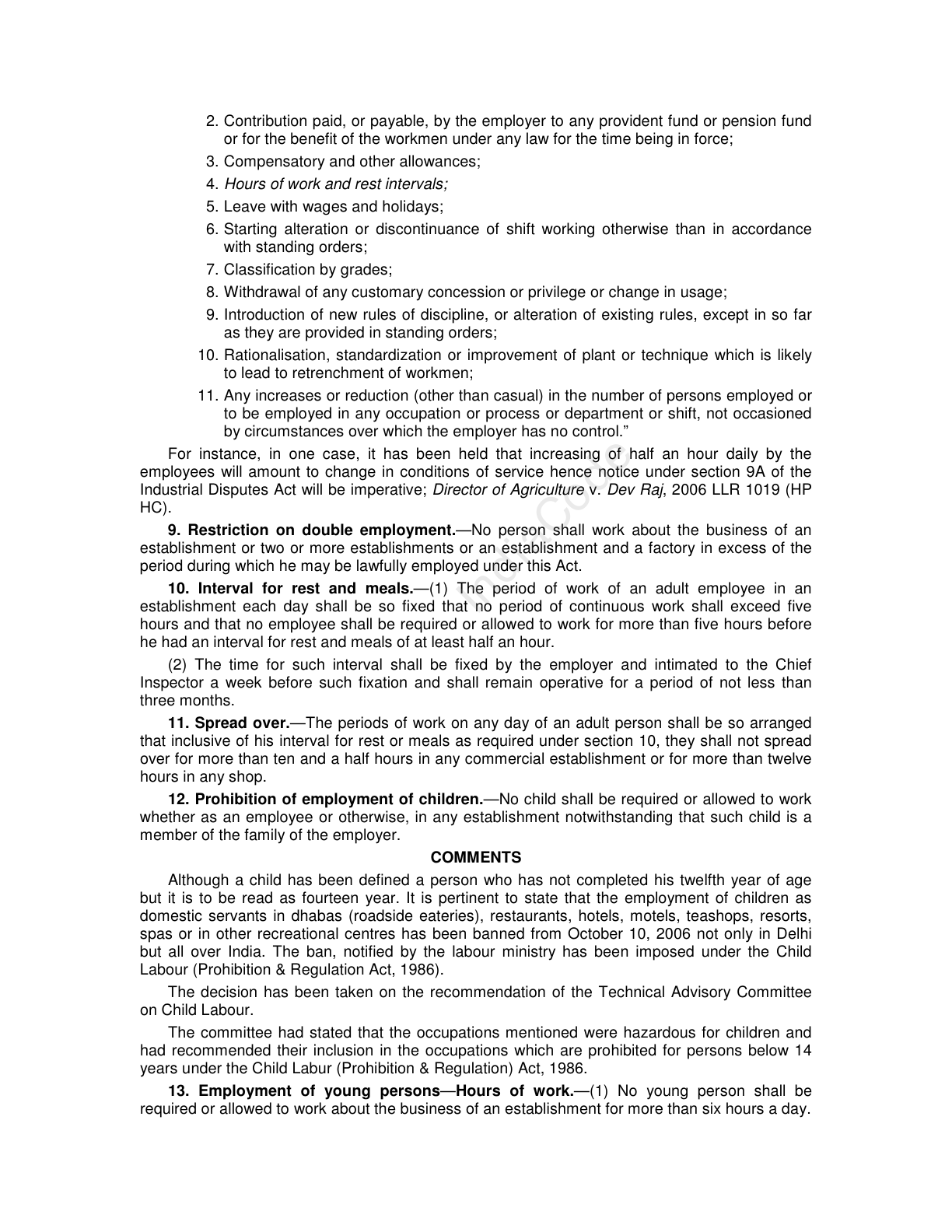
Unreviewed complete page layout text
           2. Contribution paid, or payable, by the employer to any provident fund or pension fund
              or for the benefit of the workmen under any law for the time being in force;
           3. Compensatory and other allowances;
           4. Hours of work and rest intervals;
           5. Leave with wages and holidays;
           6. Starting alteration or discontinuance of shift working otherwise than in accordance
              with standing orders;
           7. Classification by grades;
           8. Withdrawal of any customary concession or privilege or change in usage;
           9. Introduction of new rules of discipline, or alteration of existing rules, except in so far
              as they are provided in standing orders;
          10. Rationalisation, standardization or improvement of plant or technique which is likely
              to lead to retrenchment of workmen;
          11. Any increases or reduction (other than casual) in the number of persons employed or
              to be employed in any occupation or process or department or shift, not occasioned
              by circumstances over which the employer has no control.”
    For instance, in one case, it has been held that increasing of half an hour daily by the
                                                                    e
employees will amount to change in conditions of service hence notice under section 9A of the
                                                              od
Industrial Disputes Act will be imperative; Director of Agriculture v. Dev Raj, 2006 LLR 1019 (HP
HC).
                                                       aC
    9. Restriction on double employment.—No person shall work about the business of an
establishment or two or more establishments or an establishment and a factory in excess of the
                                                   di
period during which he may be lawfully employed under this Act.
    10. Interval for rest and meals.—(1) The period of work of an adult employee in an
                                              In
establishment each day shall be so fixed that no period of continuous work shall exceed five
hours and that no employee shall be required or allowed to work for more than five hours before
he had an interval for rest and meals of at least half an hour.
    (2) The time for such interval shall be fixed by the employer and intimated to the Chief
Inspector a week before such fixation and shall remain operative for a period of not less than
three months.
    11. Spread over.—The periods of work on any day of an adult person shall be so arranged
that inclusive of his interval for rest or meals as required under section 10, they shall not spread
over for more than ten and a half hours in any commercial establishment or for more than twelve
hours in any shop.
    12. Prohibition of employment of children.—No child shall be required or allowed to work
whether as an employee or otherwise, in any establishment notwithstanding that such child is a
member of the family of the employer.
                                             COMMENTS
    Although a child has been defined a person who has not completed his twelfth year of age
but it is to be read as fourteen year. It is pertinent to state that the employment of children as
domestic servants in dhabas (roadside eateries), restaurants, hotels, motels, teashops, resorts,
spas or in other recreational centres has been banned from October 10, 2006 not only in Delhi
but all over India. The ban, notified by the labour ministry has been imposed under the Child
Labour (Prohibition & Regulation Act, 1986).
    The decision has been taken on the recommendation of the Technical Advisory Committee
on Child Labour.
    The committee had stated that the occupations mentioned were hazardous for children and
had recommended their inclusion in the occupations which are prohibited for persons below 14
years under the Child Labur (Prohibition & Regulation) Act, 1986.
    13. Employment of young persons—Hours of work.—(1) No young person shall be
required or allowed to work about the business of an establishment for more than six hours a day.