Source appendix · Central source snapshot
STATEMENT OF OBJECTS AND REASONS
Sexual Harassment of Women at Workplace (Prevention, Prohibition and Redressal) Act, 2013 · source PDF pages 17
This explanatory source appendix is not presented as an operative provision.
Source citation: STATEMENT OF OBJECTS AND REASONS, Sexual Harassment of Women at Workplace (Prevention, Prohibition and Redressal) Act, 2013 (Act No. 14 of 2013), Source appendix, Central source snapshot, source PDF pp. 17; snapshot SHA256 e212dcd55dbb418f0a3ae0a12f3203e67d5466da1238d18a3cb4317971afa9e2 (current applicability unverified)
Exact extracted layout text
Spacing, line breaks, footnotes and extraction artifacts are retained. Scroll horizontally for wide tables. Use the original page images to check columns, forms and figures; extracted text is not an accessible table model.
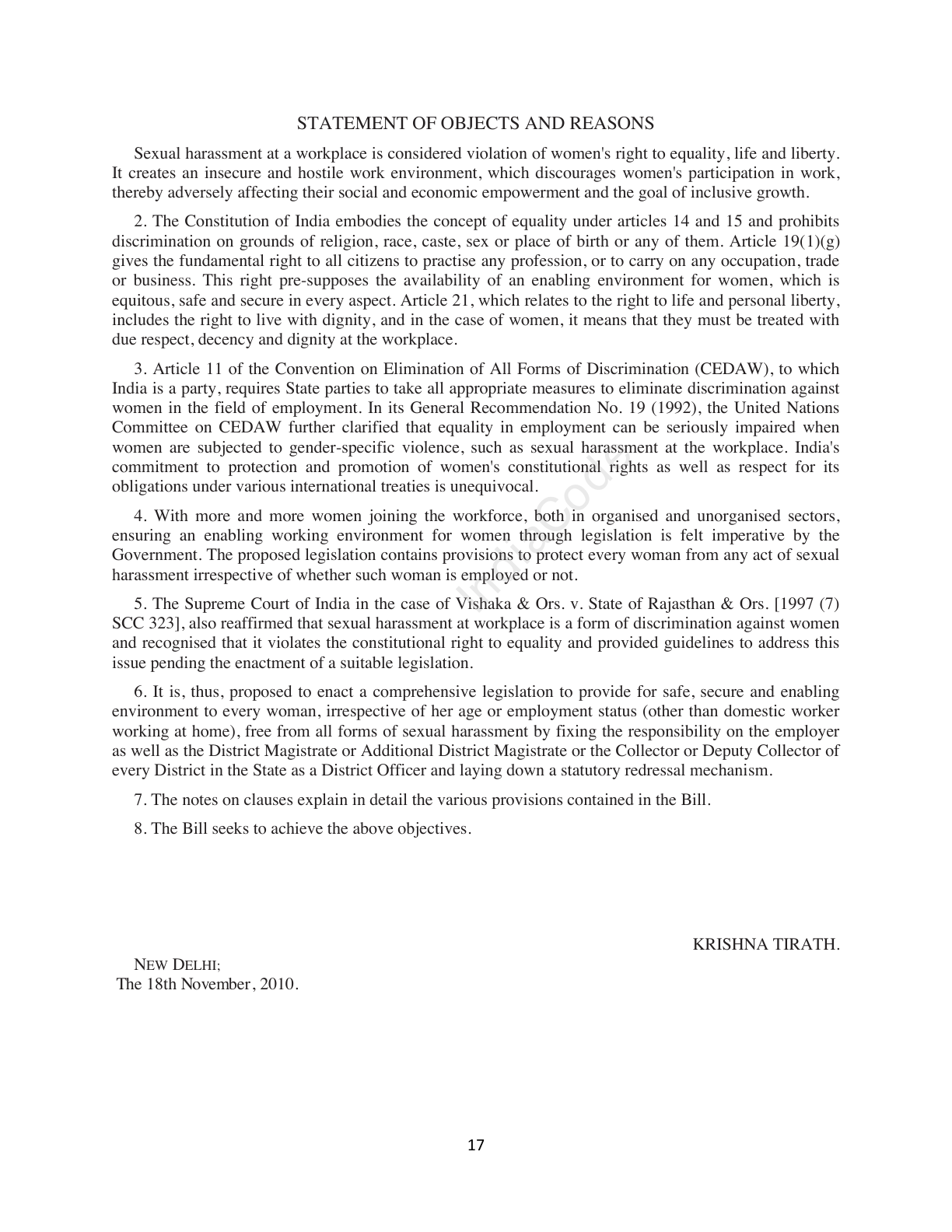
                            STATEMENT OF OBJECTS AND REASONS
    Sexual harassment at a workplace is considered violation of women's right to equality, life and liberty.
It creates an insecure and hostile work environment, which discourages women's participation in work,
thereby adversely affecting their social and economic empowerment and the goal of inclusive growth.
   2. The Constitution of India embodies the concept of equality under articles 14 and 15 and prohibits
discrimination on grounds of religion, race, caste, sex or place of birth or any of them. Article 19(1)(g)
gives the fundamental right to all citizens to practise any profession, or to carry on any occupation, trade
or business. This right pre-supposes the availability of an enabling environment for women, which is
equitous, safe and secure in every aspect. Article 21, which relates to the right to life and personal liberty,
includes the right to live with dignity, and in the case of women, it means that they must be treated with
due respect, decency and dignity at the workplace.
   3. Article 11 of the Convention on Elimination of All Forms of Discrimination (CEDAW), to which
India is a party, requires State parties to take all appropriate measures to eliminate discrimination against
women in the field of employment. In its General Recommendation No. 19 (1992), the United Nations
Committee on CEDAW further clarified that equality in employment can be seriously impaired when
women are subjected to gender-specific violence, such as sexual harassment at the workplace. India's
                                                                       e
commitment to protection and promotion of women's constitutional rights as well as respect for its
obligations under various international treaties is unequivocal. od
   4. With more and more women joining the workforce, both in organised and unorganised sectors,
                                                           aC
ensuring an enabling working environment for women through legislation is felt imperative by the
Government. The proposed legislation contains provisions to protect every woman from any act of sexual
                                                        di
harassment irrespective of whether such woman is employed or not.
                                                  In
   5. The Supreme Court of India in the case of Vishaka & Ors. v. State of Rajasthan & Ors. [1997 (7)
SCC 323], also reaffirmed that sexual harassment at workplace is a form of discrimination against women
and recognised that it violates the constitutional right to equality and provided guidelines to address this
issue pending the enactment of a suitable legislation.
   6. It is, thus, proposed to enact a comprehensive legislation to provide for safe, secure and enabling
environment to every woman, irrespective of her age or employment status (other than domestic worker
working at home), free from all forms of sexual harassment by fixing the responsibility on the employer
as well as the District Magistrate or Additional District Magistrate or the Collector or Deputy Collector of
every District in the State as a District Officer and laying down a statutory redressal mechanism.
   7. The notes on clauses explain in detail the various provisions contained in the Bill.
   8. The Bill seeks to achieve the above objectives.


                                                                                        KRISHNA TIRATH.
  NEW DELHI;
The 18th November, 2010.


                                                      17
Original source pages
Expand a page to inspect it. Page numbers refer to physical PDF pages. Full pages can include neighbouring central text or notes outside this extract.
Source details and verification limits
Official source PDF · fetched 2026-10-19T23:07:31Z
- PDF SHA256
- e212dcd55dbb418f0a3ae0a12f3203e67d5466da1238d18a3cb4317971afa9e2
- Excerpt SHA256
- 10780344923ff4dadefa32f9892d3e2ea57c2ea56f076377c730e93711a26c06
- Record ID
- posh:source_appendix:statement-of-objects-and-reasons
- Extraction
- pdftotext-layout
- Layout-text retains source tables and footnotes; figures and visual fidelity require the official PDF.
- Statement of objects and reasons is explanatory source material, not an operative provision.
- Official delivered PDF bytes are pinned by SHA256; they differ from catalog checksum/size metadata. The discrepancy cause is unconfirmed.