Source appendix · Central source snapshot
STATEMENT OF OBJECTS AND REASONS
Consumer Protection Act, 2019 · source PDF pages 42
This explanatory source appendix is not presented as an operative provision.
Source citation: STATEMENT OF OBJECTS AND REASONS, Consumer Protection Act, 2019 (Act No. 35 of 2019), Source appendix, Central source snapshot, source PDF pp. 42; snapshot SHA256 4bbed366bc2206bb1c3b1817c5ccdd652d1e66d9476c6779cf5239e71e3ba2a7 (current applicability unverified)
Exact extracted layout text
Spacing, line breaks, footnotes and extraction artifacts are retained. Scroll horizontally for wide tables. Use the original page images to check columns, forms and figures; extracted text is not an accessible table model.
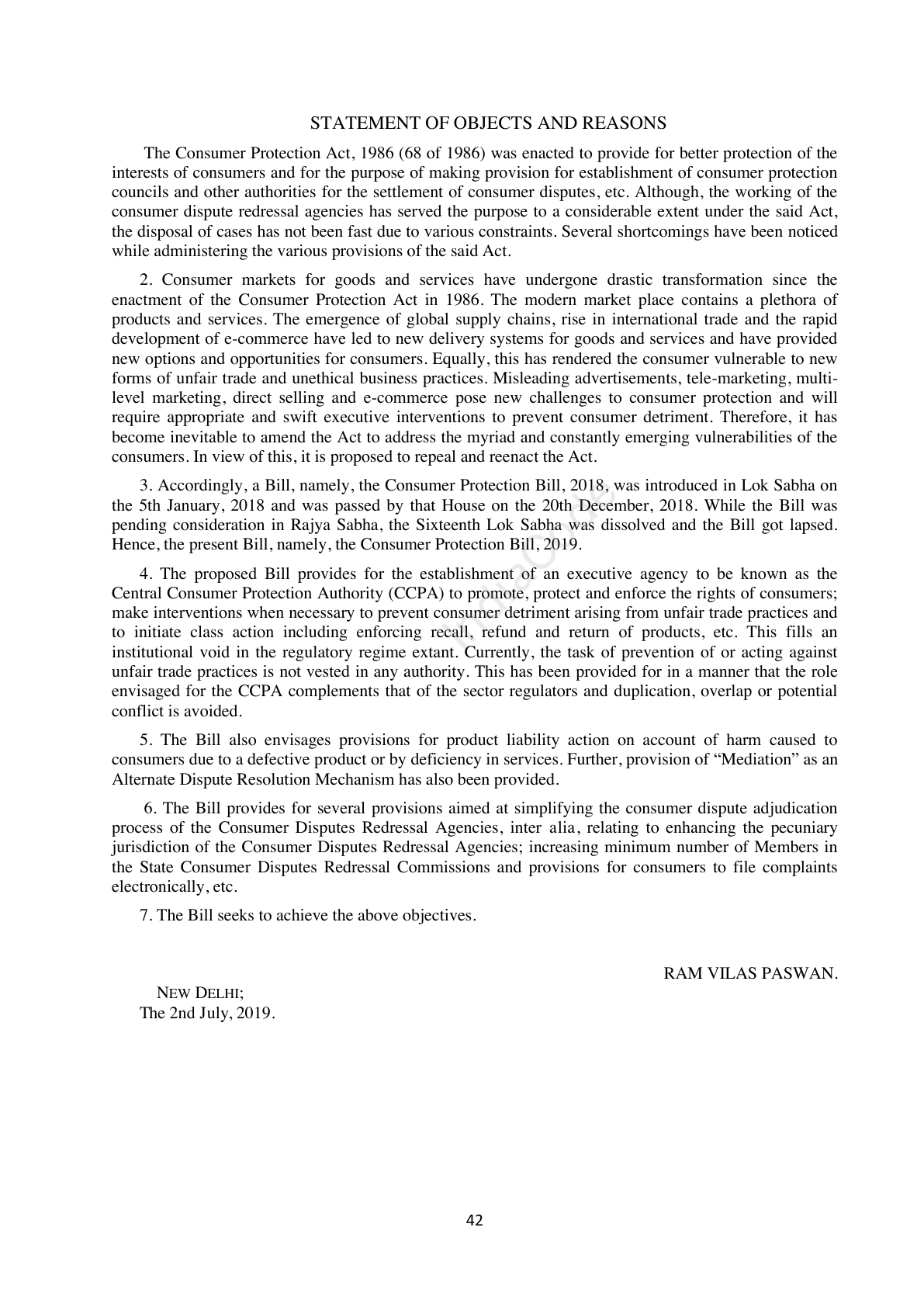
                             STATEMENT OF OBJECTS AND REASONS
     The Consumer Protection Act, 1986 (68 of 1986) was enacted to provide for better protection of the
interests of consumers and for the purpose of making provision for establishment of consumer protection
councils and other authorities for the settlement of consumer disputes, etc. Although, the working of the
consumer dispute redressal agencies has served the purpose to a considerable extent under the said Act,
the disposal of cases has not been fast due to various constraints. Several shortcomings have been noticed
while administering the various provisions of the said Act.
    2. Consumer markets for goods and services have undergone drastic transformation since the
enactment of the Consumer Protection Act in 1986. The modern market place contains a plethora of
products and services. The emergence of global supply chains, rise in international trade and the rapid
development of e-commerce have led to new delivery systems for goods and services and have provided
new options and opportunities for consumers. Equally, this has rendered the consumer vulnerable to new
forms of unfair trade and unethical business practices. Misleading advertisements, tele-marketing, multi-
level marketing, direct selling and e-commerce pose new challenges to consumer protection and will
require appropriate and swift executive interventions to prevent consumer detriment. Therefore, it has
become inevitable to amend the Act to address the myriad and constantly emerging vulnerabilities of the
consumers. In view of this, it is proposed to repeal and reenact the Act.
    3. Accordingly, a Bill, namely, the Consumer Protection Bill, 2018, was introduced in Lok Sabha on
                                                                   e
the 5th January, 2018 and was passed by that House on the 20th December, 2018. While the Bill was
                                                             od
pending consideration in Rajya Sabha, the Sixteenth Lok Sabha was dissolved and the Bill got lapsed.
Hence, the present Bill, namely, the Consumer Protection Bill, 2019.
                                                         aC
     4. The proposed Bill provides for the establishment of an executive agency to be known as the
Central Consumer Protection Authority (CCPA) to promote, protect and enforce the rights of consumers;
                                                   di
make interventions when necessary to prevent consumer detriment arising from unfair trade practices and
                                              In
to initiate class action including enforcing recall, refund and return of products, etc. This fills an
institutional void in the regulatory regime extant. Currently, the task of prevention of or acting against
unfair trade practices is not vested in any authority. This has been provided for in a manner that the role
envisaged for the CCPA complements that of the sector regulators and duplication, overlap or potential
conflict is avoided.
    5. The Bill also envisages provisions for product liability action on account of harm caused to
consumers due to a defective product or by deficiency in services. Further, provision of “Mediation” as an
Alternate Dispute Resolution Mechanism has also been provided.
     6. The Bill provides for several provisions aimed at simplifying the consumer dispute adjudication
process of the Consumer Disputes Redressal Agencies, inter alia, relating to enhancing the pecuniary
jurisdiction of the Consumer Disputes Redressal Agencies; increasing minimum number of Members in
the State Consumer Disputes Redressal Commissions and provisions for consumers to file complaints
electronically, etc.
    7. The Bill seeks to achieve the above objectives.


                                                                                 RAM VILAS PASWAN.
      NEW DELHI;
    The 2nd July, 2019.


                                                    42
Original source pages
Expand a page to inspect it. Page numbers refer to physical PDF pages. Full pages can include neighbouring central text or notes outside this extract.
Source details and verification limits
Official source PDF · fetched 2026-10-19T23:07:19Z
- PDF SHA256
- 4bbed366bc2206bb1c3b1817c5ccdd652d1e66d9476c6779cf5239e71e3ba2a7
- Excerpt SHA256
- 4d8ebbd8c2f149f127cb451f0f4801d2111ba6c6d253f5f8fee107860c010a0a
- Record ID
- cpa:source_appendix:statement-of-objects-and-reasons
- Extraction
- pdftotext-layout
- Layout-text retains source tables and footnotes; figures and visual fidelity require the official PDF.
- Statement of objects and reasons is explanatory source material, not an operative provision.
- Official delivered PDF bytes are pinned by SHA256; they differ from catalog checksum/size metadata. The discrepancy cause is unconfirmed.